The Agentic Shift: Moving from Chatbots to Digital Coworkers
In 2023, most enterprises still thought of AI as “that chatbot on the website.” It could answer FAQs, maybe reset a password, and occasionally frustrate customers enough that they begged for a human. By 2026, that mental model is breaking down. We’re no longer just chatting with AI — we’re coworking with it.
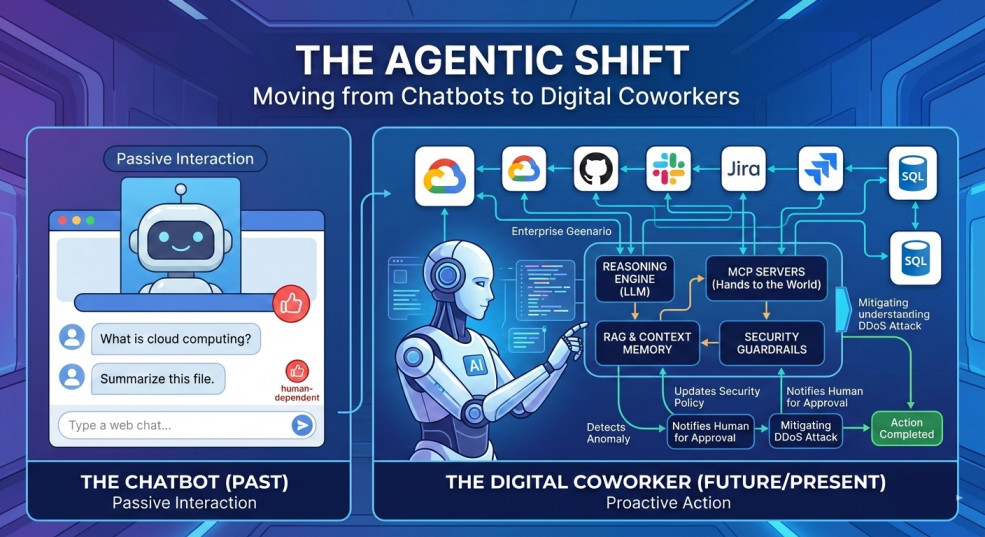
This is the agentic shift: moving from AI that responds to messages to AI that owns outcomes.
From Chatbots That Talk to Agents That Work
Traditional chatbots were essentially interactive IVR systems with better UX. They waited for inputs, matched them to scripted flows, and produced pre-approved responses. When they failed, they failed loudly: circular conversations, dead ends, and “Sorry, I didn’t get that” loops.
Agentic AI turns that pattern inside out:
- It perceives signals across systems, not just chat messages: tickets, logs, emails, metrics.
- It reasons about goals and constraints, not just FAQ matches.
- It acts directly on tools and APIs to complete multi-step workflows.
- It learns from outcomes over time, adapting policies and playbooks.
One vendor calls this the shift from “ticket deflection” to “digital colleagues,” and that phrasing is starting to stick.
The Moment the Bot Became a Coworker
To feel the difference, imagine this scenario.
You’re the IT lead for a 5,000-person company. In 2022, you deployed a chatbot on your IT portal. It could:
- Answer “How do I connect to VPN?”
- Route people to the right help article.
- Create tickets for anything more complicated.
It was useful, but it was essentially a glorified router.
Now fast-forward to 2026.
An employee types into your internal help channel: “My laptop keeps dropping from Wi-Fi during calls. I’ve tried restarting, no luck.”
A digital coworker, let’s call it Nova, steps in. Here’s what Nova does without a human in the loop.
- Looks up the user’s device, OS, and recent incident history in ITSM.
- Pulls telemetry from the endpoint management system.
- Detects a known driver issue affecting a specific hardware batch.
- Pushes the correct driver update, verifies installation, and runs a quick connectivity test.
- Updates the incident, notifies the employee with a short summary, and closes the ticket.
At no point did Nova ask anyone for permission to “try a few steps.” It executed an end-to-end workflow across multiple systems, logged everything, and escalated only if verification failed.
That’s not a chatbot. That’s a digital coworker embedded in your IT team.
Real-World Signals: This Shift Is Already Underway
This isn’t just slideware. Over the past 18–24 months, several data points have quietly marked the arrival of agentic AI in the enterprise:
- Analysts now forecast that by 2025, around 60% of enterprises will have replaced traditional chatbots with autonomous AI agents as their primary interface for employee and customer workflows.
- In customer service setups where AI agents augment humans, teams see a 74% reduction in first response time, 56% shorter handle times, and CSAT jumps from 78% to 97%.
- One publicly shared case: a client replaced three full-time operational roles with a single AI agent, achieving 24/7 coverage and roughly 70% cost reduction while maintaining service levels.
- Agentic internal support assistants, like the HelpBot deployed at Power Design, now autonomously reset credentials, troubleshoot devices, and integrate with monitoring systems to resolve IT issues end-to-end, not just “answer questions.”
When you zoom out, a pattern emerges: the biggest gains don’t come from “better answers,” but from completed workflows and fewer repeat touches. For example, AI agents have been shown to reduce repeat inquiries by about 25% due to more accurate first-time resolutions.
Chatbots vs Digital Coworkers
Here’s a simple way to contrast the old world and the new.
| Dimension | Traditional Chatbots | Digital Coworkers (AI Agents) |
|---|---|---|
| Primary goal | Answer questions | Own and complete tasks end-to-end |
| Interaction model | User asks, bot replies | User sets intent, agent plans and acts |
| Logic | Scripts and intent trees | Reasoning over goals, tools, and constraints |
| Systems access | FAQ, knowledge base | Direct API access to apps, data, and automation platforms |
| Autonomy | Low - escalate quickly to humans | High - acts independently with guardrails |
| Learning | Manual re-training of flows | Continuous learning from outcomes and feedback |
| Metrics that matter | Containment, deflection | Automation rate, solution rate, CSAT, NPS, business KPIs |
| Mental model | “Smart IVR” | “Specialist colleague on the team” |
One McKinsey view on agentic AI puts it plainly: success is less about the model and more about designing the work system around these agents, goals, guardrails, metrics, and collaboration patterns. [mckinsey]
How Enterprises Are Actually Using Digital Coworkers
Across industries, these agents are quietly taking on roles we used to reserve for junior staff, offshore teams, or endless RPA scripts.
IT and Operations: From Firefighting to Self-Healing
In IT service management, we’re seeing a transition “from chatbots to autonomous AI agents that perceive, reason, act, and learn,” delivering more resilient, proactive operations.
Some common patterns:
- Multi-agent IT “squads”: diagnosis agents, remediation agents, validation agents, documentation agents working as a digital team.
- Automated incident response: agents monitor logs, trigger remediation scripts, and notify humans only when anomalies fall outside learned patterns.
- Internal support: systems like Power Design’s HelpBot handle routine IT issues and escalate only the complex 10–20%.
In effect, the human role shifts from “hands on keyboard” to “orchestrator of a digital workforce.”
HR and Employee Services: A 24/7 Service Desk
HR is another hotspot. Agentic AI is being used to answer benefits questions, update employee records, route approvals, and streamline onboarding.
Ciena, for example, implemented an agentic system that connects into HR and IT platforms to.
- Interpret employee requests in natural language.
- Take secure actions like updating records or provisioning access.
- Coordinate workflows, such as onboarding, across departments, end-to-end.
Instead of “check the policy PDF,” employees get a colleague-like experience: “I’ve updated your benefits selection and sent your new ID to your email.”
Customer Support: Beyond Deflection
Customer support metrics tell a similar story. Modern AI agents are tracked on
- Deflection: issues handled without humans.
- Automation: workflows fully completed by AI.
- Solution rate: customer-confirmed resolutions.
- CSAT and NPS: satisfaction and loyalty.
In real deployments, AI-augmented teams handle up to 3x more tickets, with solution rates and CSAT both climbing instead of trading one off against the other.
The narrative is changing from “bots to cut costs” to “digital coworkers to improve both cost and experience.”
Why This Shift Is Happening Now
Three technology trends converged to make this possible: [o-mega]
- LLMs learned to reason
Models evolved from autocomplete engines into contextual reasoners. They can juggle multiple inputs, understand longer time horizons, and choose between tools or actions to achieve a goal, not just answer the last question. - APIs and integration layers matured
Integration frameworks now let agents safely call internal systems, CRMs, ERPs, ticketing tools, CI/CD pipelines, behind policy and identity layers. They don’t just talk about systems; they act within them. - Multi-agent architectures became practical
Instead of one monolithic bot, organizations deploy teams of specialized agents: one for planning, one for execution, one for verification, and one for documentation. Together, they resemble a small digital department.
Vendors and open-source projects, from agent frameworks to orchestration tools, have lowered the barrier so much that eMarketer could reasonably describe 2024 as the year chatbots became “productivity powerhouses” through agentic patterns.
Designing Work for a Digital Workforce
The interesting question is no longer: “What can the model do?” It’s: “How do we manage a team that isn’t entirely human?”
Forward-leaning organizations are converging on a few principles:
- Onboard agents like people, but faster
You start with a narrow scope, clear playbooks, and supervised runs. As the agent proves reliability, you expand its remit, just as you would with a new hire, only over days instead of quarters. - Move from “human in the loop” to “human on the loop”
Humans set objectives, define policies, and monitor metrics instead of approving every action. One practitioner described this as moving from asking AI to tasking AI. - Measure what actually matters
It’s not enough to say “our deflection rate is 65%.” Mature teams report things like: “Our AI handled 78% of inquiries without human escalation, with an 81% CSAT and 72% confirmed resolution rate.” - Treat agents as teammates, not tools
This means designing collaboration: how humans hand off work to agents, how agents summarize and escalate, and how responsibilities are divided by strengths.
When this is done well, people stop thinking of AI as “that system” and start saying things like, “Can we assign this to the finance agent?” or “Let the support agent triage this backlog overnight.”
The Strategic Question: Are You Still Chatting, or Are You Coworking?
An AI leader would summarize the shift this way
- 2023: “We use AI tools.”
- 2024–2025: “We have AI employees.”
That framing may be provocative, but the underlying economic reality is hard to ignore. When a single well-designed agent can replace multiple FTEs for bounded workflows, operate 24/7, and plug directly into your systems, the competitive line moves from “Who has AI?” to “Who has the best digital workforce?”
For leaders, the question is no longer whether to deploy AI, but how quickly they can:
- Identify workflows where agents can safely own outcomes.
- Put in place the guardrails, observability, and metrics to keep them aligned.
- Redesign roles so humans spend more time orchestrating and less time firefighting.
Because the real value of the agentic shift isn’t that you can chat with a smarter bot. It’s that your organization gains a set of tireless, specialized digital coworkers who quietly keep the lights on while your human teams focus on building what’s next.
Share this article


Recent Posts
The Future of Agentic AI in Enterprise Applications
Why the next 3–6 months will define enterprise AI leadership — and how product and technology leaders can prepare for agentic systems that plan, decide, orchestrate, and execute.
Integration Modernization: An Enterprise Strategy for the Connected Enterprise
A Strategic framework for CIOs, CTOs, and enterprise architects to modernize integration, reduce risk, and unlock connected enterprise velocity.
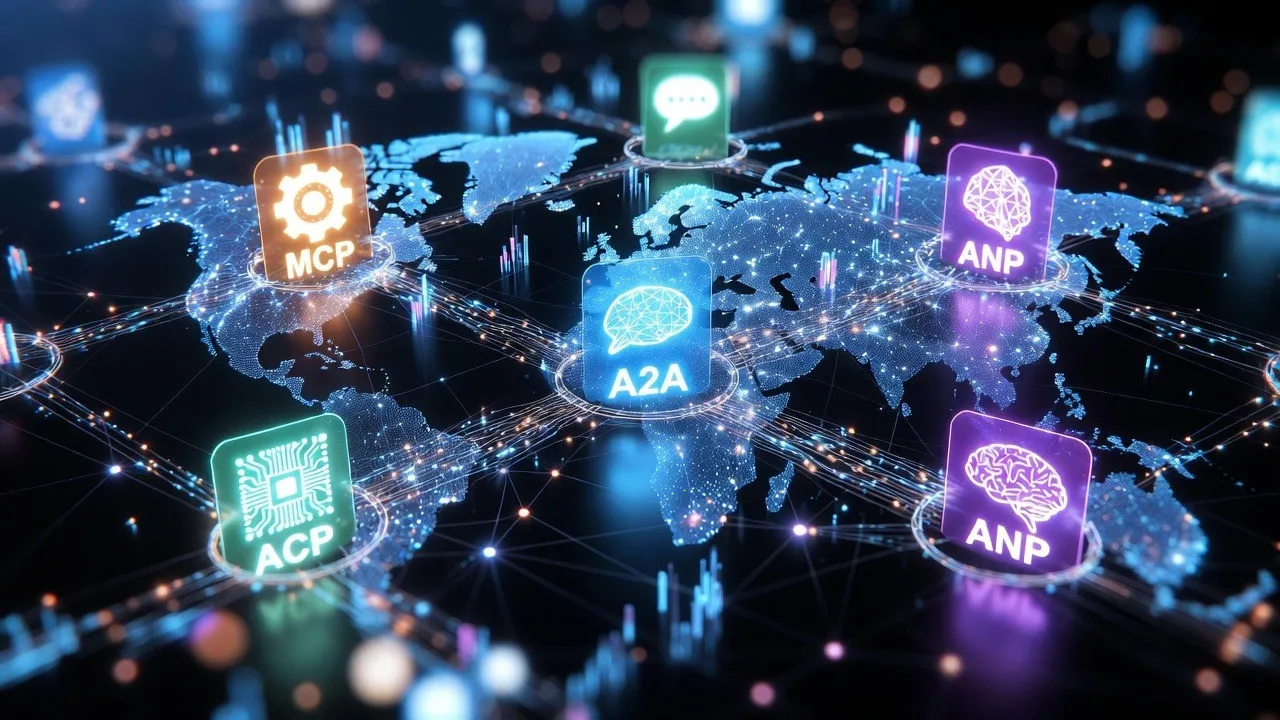
Navigating the Future of AI Agents: MCP vs. A2A vs. ACP vs. ANP
A practical breakdown of the 4 key protocols shaping interoperable AI agents—what they do, where they fit, and how to choose (MCP, A2A, ACP, ANP).

AI 101: Your Gateway to the World of Large Language Models
A practical, non-fluffy guide to AI and Large Language Models (LLMs) for developers, CXOs, and AI leaders—what they are, how they work, when to use which model, and how to get reliable answers.
Google Maps for Your Code: Rescuing Architecture with the C4 Model
How the C4 model turns messy architecture diagrams into a clear, zoomable map of your systems—so teams can align, migrate, and evolve faster.
The Iceberg Beneath Your Code: Understanding Tech Debt in Software Development
Tech debt is the hidden iceberg beneath your codebase—slowing teams, inflating risk, and threatening outages. Here’s how to see it clearly and pay it down strategically.
How Claude Code Turns Your Terminal into an Agentic Dev Team
Claude Code is a framework for composing terminal-native AI agents with subagents, skills, hooks, and plugins to automate real dev workflows with control and determinism.