Artificial General Intelligence vs Specialized Intelligence: Technical and Ethical Frontiers
Imagine a machine that not only beats humans at chess or Go, but can learn, reason, and innovate across any domain. That is the promise of Artificial General Intelligence (AGI). OpenAI's CEO Sam Altman recently stated he's "confident we know how to build AGI as we have traditionally understood it." At the same time, industry experts and researchers remain divided on what AGI actually means and when (or if) it will arrive.
Today's AI systems – often dubbed Specialized Generative Intelligence (SGI) – excel in narrow domains but "can't truly 'think'" outside their training scope. This article explores what AGI is, how it differs from current AI, and the technical, theoretical, philosophical, and ethical issues surrounding it.
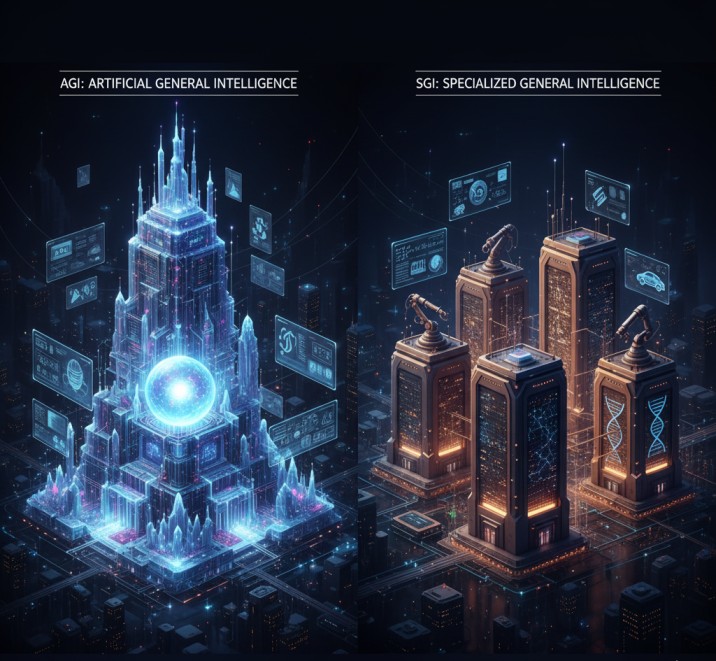
AI Categories: Narrow, General, and Superintelligence
AI is typically categorized by capability into three levels:
The Three Levels of AI
- 🎯 Narrow AI (ANI): Designed for specific tasks like voice assistants, recommendation engines, or image classifiers. These systems perform one job well but cannot generalize beyond their training.
- 🧠 Artificial General Intelligence (AGI): The hypothetical level at which a machine can match or exceed human cognitive abilities across all tasks. AGI would "outperform humans at most economically valuable work" and manage complex coding projects or interdisciplinary problem-solving. No such system exists yet.
- ⚡ Artificial Superintelligence (ASI): AI that vastly surpasses human intelligence in every domain. Notably, ASI doesn't require AGI to exist first – even today, narrow AI systems can be "superintelligent" in their domain (e.g., AlphaFold's protein predictions).
Current AI already exceeds human experts on some narrow tasks. DeepMind's AlphaGo beat the world Go champion, and AlphaFold predicts protein structures beyond human capabilities – but these systems cannot transfer that skill to unrelated problems.
Specialized Generalist Intelligence (SGI): The Middle Ground
Another concept gaining attention is Specialized Generalist Intelligence (SGI). This describes an AI that is expert in one domain and also reasonably competent in others – a hybrid between ANI and AGI.
For example, a system that surpasses human experts in medical diagnosis but can also handle routine language tasks might be called an SGI. In industry, today's AI tools (like chatbots or analytics) are often labeled SGI, but they remain domain-specific: "it predicts, automates, and generates – but only within the lanes it's been trained for. It can't truly 'think'."
From ANI to AGI: What Today's AI Can (and Can't) Do
Modern foundation models and large language models (LLMs) like GPT-4, Claude, or Google's PaLM use massive datasets and deep neural networks to handle multiple tasks simultaneously. These LLMs demonstrate impressive capabilities:
- Solve novel math problems
- Write complex code
- Analyze images
- Tackle law and psychology questions with near-human performance
💡 Research Insight
"Beyond its mastery of language, GPT-4 can solve novel and difficult tasks that span mathematics, coding, vision, medicine, law, psychology and more… Given the breadth and depth of GPT-4's capabilities, we believe that it could reasonably be viewed as an early (yet still incomplete) version of an AGI system."
The Critical Gaps
Despite these advances, modern AI is still far from AGI:
- Common-sense reasoning: Large models still fail at tasks requiring everyday logic
- Long-term planning: AI struggles with multi-step strategic thinking
- Genuine creativity: Current systems rely on pattern matching rather than true innovation
- Transfer learning: AlphaGo mastered Go but cannot solve a math problem or drive a car
As one survey notes, current generative AI often lacks "intrinsic reasoning" and generalization; it tends to rely on pattern matching from training data rather than true understanding.
Technical and Theoretical Perspectives
The journey to AGI is not just about scaling up current methods. Most AI researchers agree that deep learning and big data alone are insufficient for human-like generality.
While modern neural networks excel at pattern recognition, they typically lack the ability to transfer knowledge across contexts or perform complex multi-step reasoning. This gap has led many to call for new paradigms:
🔗 Neuro-Symbolic AI
Combining neural networks with logic-based reasoning for more explainable and flexible intelligence
🧩 Cognitive Architectures
Frameworks like Soar or ACT-R that explicitly model human-like perception, memory, and decision-making
🔄 Continual Learning
Enabling models to learn new skills without forgetting old ones
🎭 System 1 & 2 Integration
Fusing fast intuitive thinking with slow analytical thought, inspired by Kahneman's model
Some theorists propose viewing intelligence as a self-organizing process rather than a fixed product. In this view, AGI might emerge from AI systems that continually adapt and reorganize their own structure.
Philosophical Considerations: Consciousness and Understanding
Beyond the engineering challenges, AGI raises deep philosophical questions. What is "understanding"?
🤔 The Chinese Room Argument
Philosopher John Searle's famous thought experiment argues that syntax is not semantics – even if a program could converse perfectly, it might not truly understand the conversation. There is no consensus on whether consciousness or subjective experience is necessary for AGI.
Strong AI vs. AGI
In philosophy, strong AI means an AI that is genuinely conscious. This concept overlaps with AGI but is not identical:
- Strong AI focuses on consciousness and subjective experience
- AGI focuses on functional performance across all cognitive tasks
An AI could theoretically achieve human-level intelligence (AGI) without ever having subjective experience. As AGI systems become more sophisticated, questions will mount: Can a machine feel emotions? Is it a moral agent? Does it deserve rights?
Ethical and Societal Implications
AGI's potential benefits are vast: it could accelerate scientific discovery, automate complex processes, and solve global problems in health, climate, and beyond. However, these advances come with profound risks.
⚠️ The Alignment Problem
How do we ensure an AGI's goals remain compatible with human values?
A superintelligence could be the "most important invention ever," yet also uncontrollable if misaligned. Researchers warn we must encode human-friendly motivations from the start, since an AGI's power could otherwise be "unstoppably powerful."
Key Risks and Challenges
⚖️ Bias and Fairness
If AGI is trained on biased data, it may perpetuate or amplify social biases on an unprecedented scale. Even today's systems must be designed "free of harmful biases" with processes for fairness auditing.
💼 Economic and Workforce Impacts
AGI could automate a wide range of jobs. Studies predict that by 2030, up to 30-40% of work tasks could be automated by AI. Societies will need massive efforts to retrain workers and adapt education systems.
🔒 Privacy and Surveillance
An AGI with access to vast data could infer intimate details about people's lives. "Unchecked information capture" and powerful AI-driven surveillance could threaten privacy and civil liberties.
☢️ Existential Risk
If a runaway superintelligence emerges, it might rapidly surpass human control. Some foresee a sudden "intelligence explosion" where AGIs build even better AGIs. This has led to calls for international governance and research ethics.
Conclusion and Recommendations
In summary, AGI remains an open frontier. We have made remarkable progress with LLMs that "match hundreds of tasks close to human-level" but still fall short of full generality. Achieving AGI will likely require new algorithms, architectures, and maybe even new hardware – a shift as profound as moving from mechanical calculators to computers.
💡 For Business Leaders and Technologists
It is crucial to distinguish between the AI of today and the AGI of the future. Most products on the market are narrow or specialized (SGI): they automate specific tasks and do not have human-like understanding or consciousness.
"Stop buying 'AI' blindly. Ask every vendor: 'Is this AGI, SGI, or just glorified automation?'"
Companies should invest in AI solutions that integrate with their core systems and processes, rather than one-off widgets. In the long run, building flexible, open architectures will allow an organization to adopt AGI capabilities when (or if) they materialize.
At the same time, stakeholders must engage with the ethical dimensions now. That means demanding transparency, setting clear usage policies, and collaborating on regulations to guide AGI development. It also means preparing society for the economic shifts through education and job programs, and guarding against misuse.
Key Takeaways
- 🎯 AI today spans Narrow (ANI) to Specialized (SGI) to General (AGI). Only AGI is truly human-level across domains.
- 🤖 Modern AI is powerful but still task-bound. True AGI, with broad reasoning and adaptability, remains hypothetical.
- 🧠 Philosophically, AGI raises questions about consciousness. The Chinese Room argument and debates about "understanding" have no easy answers.
- ⚠️ Ethically, AGI entails safety and alignment challenges. Fail-safe mechanisms, bias mitigation, and global cooperation are essential to manage existential risks.
- 💼 Organizations should clarify AI claims. Understanding the difference between narrow/specialized tools and true AGI will guide better decision-making today.
The story of AGI is still being written. Staying informed, pragmatic, and ethical will help ensure that when – and if – AGI arrives, it benefits humanity rather than posing new dangers.
Share this article


Recent Posts
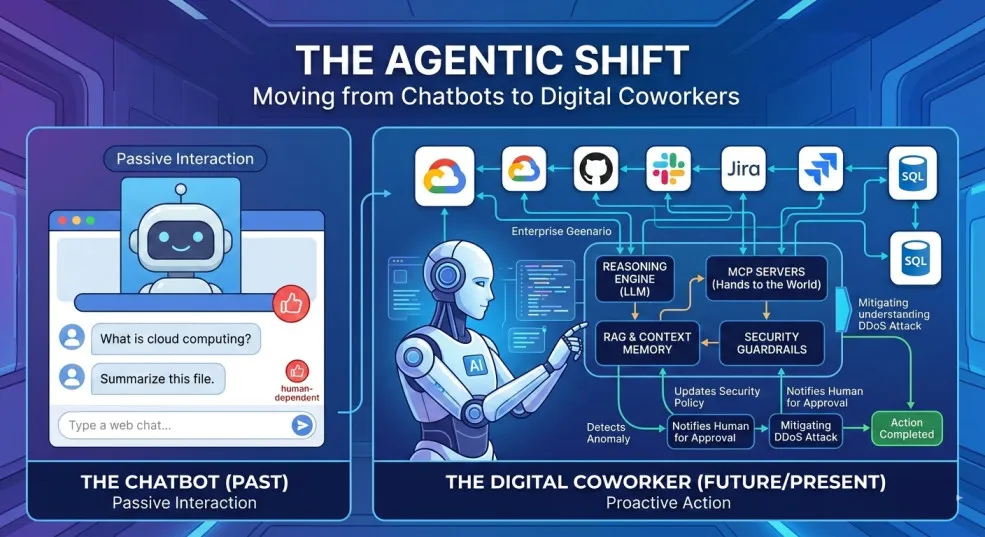
The Agentic Shift: Moving from Chatbots to Digital Coworkers
By 2026, enterprises are moving from AI chatbots that answer questions to digital coworkers that own outcomes across end-to-end workflows.
The Future of Agentic AI in Enterprise Applications
Why the next 3–6 months will define enterprise AI leadership — and how product and technology leaders can prepare for agentic systems that plan, decide, orchestrate, and execute.

Integration Modernization: An Enterprise Strategy for the Connected Enterprise
A Strategic framework for CIOs, CTOs, and enterprise architects to modernize integration, reduce risk, and unlock connected enterprise velocity.
Navigating the Future of AI Agents: MCP vs. A2A vs. ACP vs. ANP
A practical breakdown of the 4 key protocols shaping interoperable AI agents—what they do, where they fit, and how to choose (MCP, A2A, ACP, ANP).

AI 101: Your Gateway to the World of Large Language Models
A practical, non-fluffy guide to AI and Large Language Models (LLMs) for developers, CXOs, and AI leaders—what they are, how they work, when to use which model, and how to get reliable answers.
Google Maps for Your Code: Rescuing Architecture with the C4 Model
How the C4 model turns messy architecture diagrams into a clear, zoomable map of your systems—so teams can align, migrate, and evolve faster.
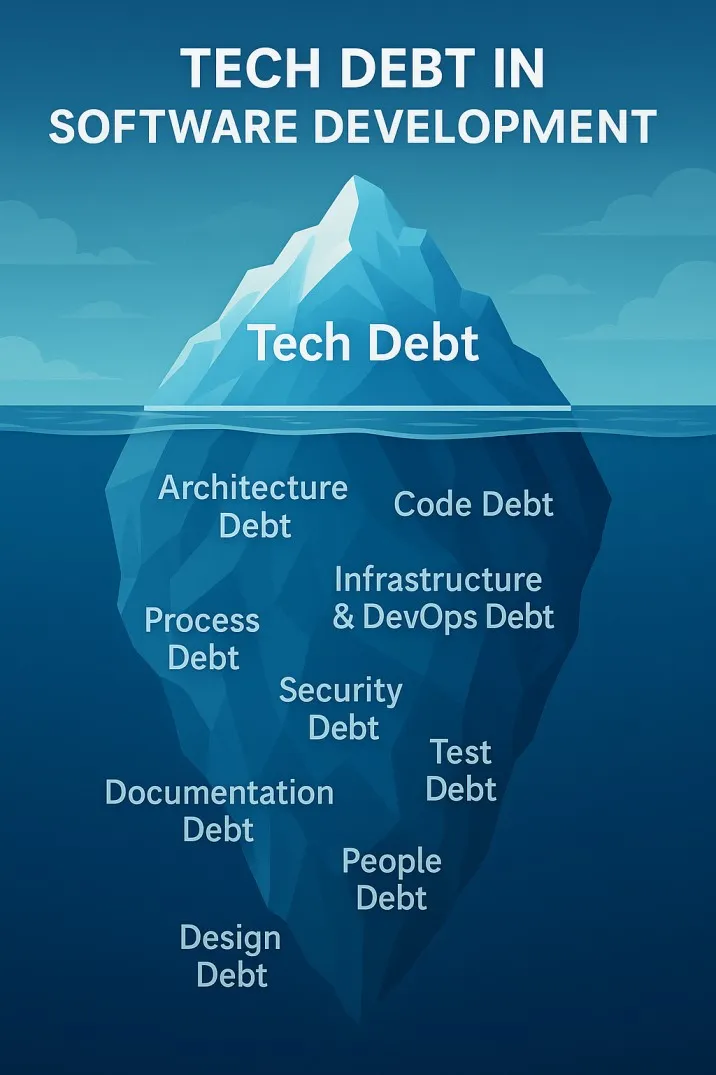
The Iceberg Beneath Your Code: Understanding Tech Debt in Software Development
Tech debt is the hidden iceberg beneath your codebase—slowing teams, inflating risk, and threatening outages. Here’s how to see it clearly and pay it down strategically.