The Agent Harness: The Missing Operating System for Enterprise AI Agents
Why the race to build more AI agents may be creating a new class of enterprise risk—and how a well-designed harness turns probabilistic models into dependable digital workers.
An enterprise does not fail with AI agents because its model is insufficiently intelligent. It fails because the model is allowed to act without the systems, controls, and feedback loops that make action dependable.
A global enterprise launches an AI case-resolution assistant. Its mandate sounds simple: interpret incoming requests, retrieve relevant policies and records, identify the next best action, draft a response, and initiate an approved workflow.
In the demonstration, it is remarkable. The agent finds information across systems, summarizes complex cases, calls the right tools, and produces a convincing recommendation in seconds. Leadership sees a future of faster operations, lower service costs, and a more productive workforce.
Then comes production.
One day, the agent retrieves an outdated policy. On another, it misinterprets a tool parameter and creates a duplicate request. A malicious instruction embedded in a connected document attempts to alter its behavior. During an escalation, the operations team cannot explain why the agent chose a particular action—or reconstruct which data, tools, and policies shaped its decision.
The organization has not deployed a dependable digital worker. It has deployed an intelligent but insufficiently governed actor.
The gap between an impressive demo and a production-grade agent is the AI agent harness.
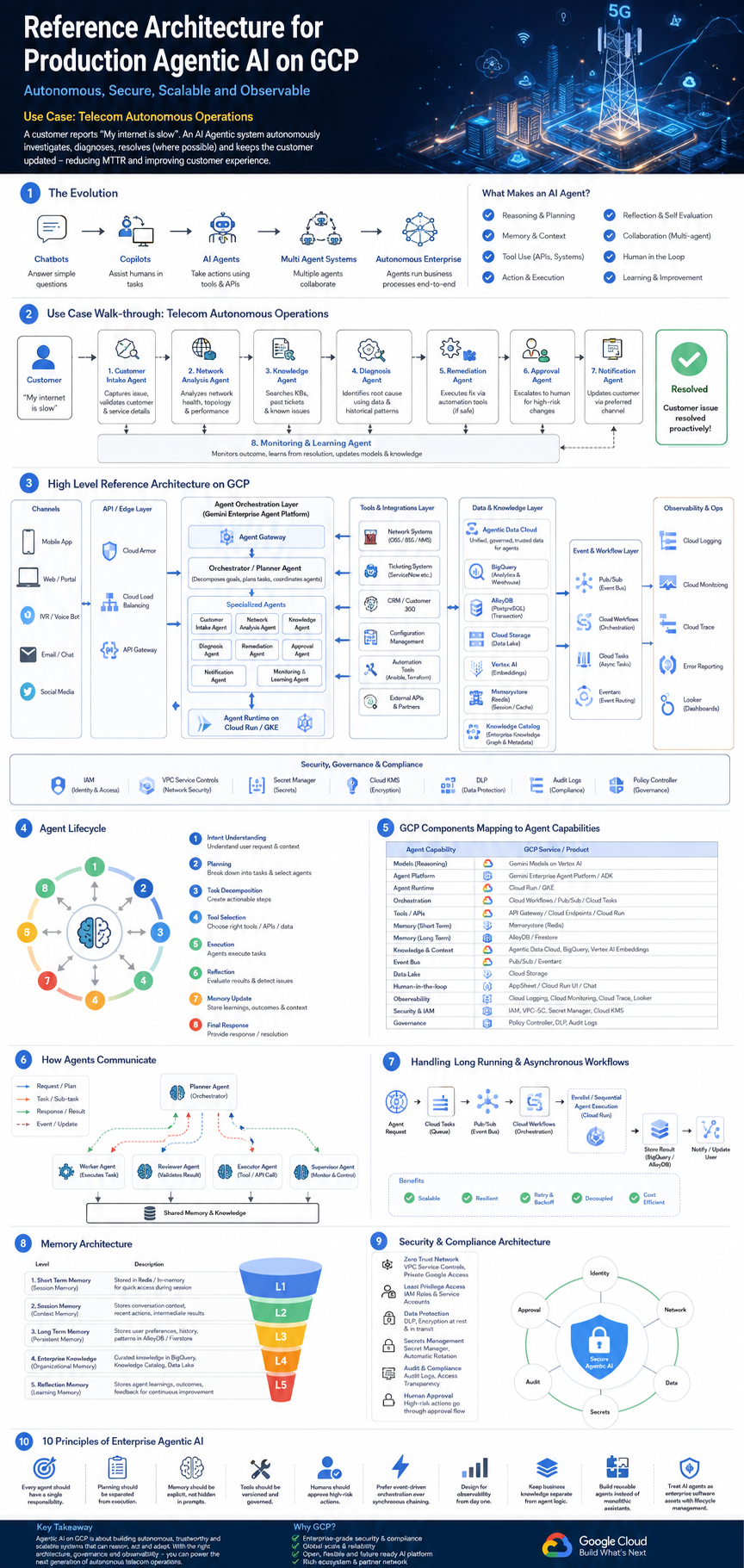
Microsoft defines an agent harness as runtime scaffolding that turns a language model into an agent able to perform work: it drives model and tool calls, manages context and conversation state, applies approval policies, and helps the agent complete multi-step tasks. learn.microsoft
From Models to Managed Agency
The first phase of enterprise generative AI was model-centric. Organizations focused on selecting a model, crafting prompts, and putting a conversational interface in front of employees or customers.
The agentic phase is different.
An AI agent may interpret an objective, make a plan, retrieve enterprise information, call tools, delegate work, update systems of record, and persist state across a multi-step task. This expands its potential value—but it also expands its failure surface.
Anthropic’s guidance on effective agents emphasizes the importance of simple designs, transparent planning, and carefully designed interfaces between agents and tools. The message for enterprise architects is straightforward: model intelligence does not replace runtime engineering. anthropic
The harness is the operating system for agentic work.
| Layer | Primary question | Example |
|---|---|---|
| Model | Can the system reason and generate? | Select an LLM suitable for classification, planning, or synthesis |
| Agent | Can the system pursue an objective? | Investigate why a service request is delayed |
| Harness | Can it pursue that objective safely and reliably? | Control context, enforce approvals, validate actions, trace execution, and recover from failure |
| Platform | Can the organization operate many agents at scale? | Shared identity, registry, governance, telemetry, evaluations, and FinOps |
Without a harness, an organization has a capable model connected to enterprise systems. With a harness, it has an engineered system of managed agency.
Why Agent Harnesses Matter
The promise of AI agents is clear: they can reduce manual effort, speed up decisions, improve service quality, and coordinate work across fragmented systems.
But when agents can act, their risk profile changes. A misleading chatbot answer can be corrected. A misleading or unauthorized action—such as changing a customer record, initiating a refund, triggering a workflow, exposing sensitive data, or altering infrastructure—can create financial, regulatory, security, and reputational consequences.
An agent harness makes operational confidence possible by answering questions that every enterprise should be able to answer:
- What context did the agent receive?
- Which source systems supplied that information?
- Was the information current and authorized?
- What plan did the agent create?
- Which tools did it call and with what parameters?
- Which policy allowed, blocked, or escalated the action?
- Did the action succeed in the target system?
- Can the run be reproduced, explained, and audited?
- What did it cost?
- Can the action be stopped, reversed, or compensated for?
If these questions cannot be answered, the organization may have an interesting prototype—but not an enterprise-grade agent.
The Cost of Operating Without a Harness
Imagine a business unit that develops an AI case-resolution agent. The agent classifies incoming requests, retrieves policies and account information, identifies the right operational team, drafts communications, and initiates service workflows.
The team gives it a system prompt, several API tools, and a retrieval layer. The initial results are excellent. Soon, it is connected to customer data, knowledge repositories, workflow platforms, and collaboration tools.
What could go wrong?
Context becomes accidental
Without controlled context, the agent may retrieve outdated policies, contradictory documents, duplicate records, or information the requesting user is not permitted to access. It may confuse a draft with an approved version or use stale commercial terms in a customer-facing recommendation.
This is not merely a model problem. It is an information supply-chain problem.
Tool use becomes unpredictable
A model infers how to use tools from their names, descriptions, examples, schemas, and responses. If a tool is vague, broad, or inconsistently documented, the agent may select the wrong operation, pass malformed parameters, repeat a failed call, or act on incomplete information.
Long-running work loses coherence
A multi-step task may span minutes, hours, or even days. Without explicit task state, checkpoints, memory boundaries, progress tracking, and context management, an agent can lose its objective, repeat work, or make inconsistent decisions.
A modern harness includes practical capabilities such as planning and execution modes, todo tracking, context compaction, file memory, file access, and managed tool approvals for long-running work. learn.microsoft
Failure becomes invisible
Traditional software follows mostly predictable code paths. Agents do not. They may plan differently, invoke tools in a different order, retry, hand off work, or stop unexpectedly.
OpenAI’s Agents SDK traces model generations, tool calls, handoffs, guardrail events, and custom events—providing the type of execution record teams need to understand and debug agent behavior. openai.github
Governance becomes retrospective
When controls are embedded inconsistently across prompts, agent code, and tools, the organization cannot confidently demonstrate why an action was taken or whether policy was followed.
The result is governance after failure instead of governance by design.
What an Agent Harness Does
An agent harness is a reusable set of runtime capabilities positioned between an agent’s reasoning loop and enterprise systems.
It is not tied to a single product or framework. An organization may use Microsoft Agent Framework, OpenAI Agents SDK, LangGraph, Semantic Kernel, Google ADK, custom services, or a combination. The harness is the architectural discipline that remains consistent even as models and frameworks evolve.
A production-grade harness has eight responsibilities.
1. Goal and task control
The harness turns a user request into a managed unit of work.
It should maintain:
- A unique task and correlation ID
- A defined objective and expected business outcome
- A task plan and execution state
- Progress checkpoints
- Completion criteria
- Time, retry, and cost budgets
- Escalation conditions
This shifts the agent from “chatting until it feels done” to executing against an explicit work contract.
2. Context engineering and memory control
The model should receive the minimum relevant, authorized, current, and attributable context required to complete a task.
The harness should manage:
- Identity-aware retrieval
- Data classification and masking
- Semantic definitions and business metadata
- Source freshness
- Source attribution and evidence capture
- Short-term task memory
- Long-term memory retention rules
- Context summarization and compaction
A vector database is useful infrastructure, but it is not an enterprise context strategy. The harness must determine what the agent is permitted to know, what evidence is relevant, how fresh it is, and whether it is sufficiently trustworthy to support action.
3. Tool mediation
Every action outside the model should pass through a controlled tool layer.
A tool gateway should:
- Validate inputs against strict schemas
- Apply least-privilege authorization
- Enforce rate, cost, and concurrency limits
- Use idempotency controls for write operations
- Normalize and sanitize tool responses
- Classify actions by risk
- Generate an auditable action trail
- Apply safe retry and error-handling rules
The key principle is simple: an agent expresses intent; the harness mediates execution.
| Action class | Example | Default control |
|---|---|---|
| Read | Retrieve a policy, ticket, or account record | Authorization check and source provenance |
| Analyze | Compare options or generate a recommendation | Grounding and output validation |
| Propose | Draft a customer credit or service request | Business-rule validation and human review |
| Commit | Update a customer record or create a purchase request | Policy gate, approval, idempotency, and audit trail |
| Irreversible | Release payment, revoke access, delete data | Strong human approval and explicit confirmation |
4. Policy and approval enforcement
Policy needs to be executable, not merely written in a governance document.
The harness should evaluate policies:
- Before a task begins
- Before sensitive context is retrieved
- Before a tool call is made
- Before an external side effect is committed
- After an output is generated
- During failure and exception handling
Tool-level guardrails can validate or block calls before execution and validate, transform, or stop unsafe results afterward. For sensitive actions, a human-review mechanism can pause a run, collect an approval or rejection, and then resume from the preserved workflow state. openai.github
A mature policy decision should consider:
- Data sensitivity
- User role and delegated authority
- Monetary or commercial impact
- Customer or employee impact
- Reversibility of the action
- Compliance obligations
- Agent confidence and uncertainty
- Whether the workflow has crossed a defined risk threshold
5. Verification and evaluation loops
An agent should not be trusted simply because it produced a plausible response.
The harness should verify:
- Whether the response is grounded in approved sources
- Whether the correct tool was selected
- Whether the tool call succeeded
- Whether the proposed action complies with business rules
- Whether the target system reflects the intended outcome
- Whether the final response is internally consistent
Verification can use deterministic rules, schemas, domain validators, policy engines, test cases, secondary models, and human reviewers. Anthropic’s evaluator-optimizer pattern uses one model to generate a response and another to assess it against explicit criteria, iteratively improving the result where appropriate. anthropic
The architectural principle is powerful:
Let the agent propose; let the harness verify.
6. Observability and traceability
Agent observability must go beyond a final answer and a generic application log.
Capture at least:
- Agent, prompt, model, tool, and policy versions
- User identity and authorization context
- Context sources and retrieval results
- Plans and state transitions
- Tool inputs, outputs, durations, and failures
- Guardrail and policy decisions
- Handoffs across agents or workflows
- Token usage and estimated cost
- Latency, retries, and exceptions
- Human approvals and overrides
- Final output and business outcome
OpenAI’s tracing model provides a useful baseline: each workflow run can emit a structured record covering model calls, tool calls, handoffs, guardrails, and custom spans. developers.openai
Traceability is not just an engineering feature. It is the evidence base for security investigations, quality improvement, cost governance, audit, and operational accountability.
7. Reliability, resilience, and recovery
Agents should be engineered as distributed systems with probabilistic decision logic.
The harness should include:
- Timeouts and circuit breakers
- Error-specific retry policies
- Checkpointing for long-running work
- Idempotency keys for write actions
- Dead-letter queues
- Compensation workflows
- Kill switches
- Feature flags
- Canary releases
- Rollback mechanisms
- Human work queues for exceptions
A simple design rule applies:
Do not let an agent initiate a consequential action unless the system can prevent duplication, detect failure, and recover safely.
8. Human interaction and accountability
Human-in-the-loop cannot be an abstract governance principle. It needs a purposeful workflow and user experience.
A reviewer should be able to see:
- The action proposed
- The evidence behind it
- The policy basis
- Expected impact
- Key uncertainty or confidence signals
- The precise action that will execute
- Options to approve, reject, edit, or escalate
- A durable audit record of the decision
The objective is not to force humans to review every low-risk action. It is to use human judgment where accountability, ambiguity, material impact, or irreversibility requires it.
A Reference Architecture
An enterprise agent harness can be organized into five layers.
+------------------------------------------------------------------+
      | Business Experience Layer                                        |
      | Customer, employee, operator, reviewer, and approval interfaces |
      +------------------------------------------------------------------+
      | Agent Runtime and Orchestration                                  |
      | Goals | planning | routing | delegation | task state | handoffs  |
      +------------------------------------------------------------------+
      | Agent Harness                                                    |
      | Context | memory | tool gateway | policy | approvals | validation|
      | Tracing | evaluation | resilience | audit | cost controls        |
      +------------------------------------------------------------------+
      | Enterprise Capability Layer                                      |
      | APIs | MCP servers | workflow engines | RAG | search | data apps |
      | CRM | ERP | ITSM | document stores | analytics | collaboration   |
      +------------------------------------------------------------------+
      | Enterprise Control Plane                                         |
      | Identity | secrets | data governance | model registry | SIEM     |
      | Observability | FinOps | compliance | incident response          |
      +------------------------------------------------------------------+
The most important design decision is to ensure that the agent does not directly own enterprise access.
The agent determines intent. The harness governs, mediates, validates, observes, and records execution.
This separation enables:
- Portability — Models and frameworks can change without rebuilding all enterprise controls.
- Consistency — Every agent follows common identity, policy, observability, and evaluation patterns.
- Risk reduction — Sensitive actions pass through shared enforcement points.
- Operational learning — The organization can measure patterns across the agent portfolio.
A Practical Guide to Harnessing an Agent
Avoid building a vast, universal platform before proving meaningful use cases. Start with a bounded workflow, but design the underlying harness capabilities as reusable enterprise products.
Step 1: Choose a bounded, high-value workflow
Start with work that has:
- A clear business outcome
- Defined inputs and systems of record
- Measurable success criteria
- Limited initial blast radius
- A human fallback path
- Sufficient volume or business importance
Good starting points include employee-support assistance, IT incident triage, document analysis, service operations, internal knowledge workflows, and recommendation-based processes.
Avoid beginning with autonomous payments, employment decisions, safety-critical operations, production infrastructure changes, or other irreversible actions.
Step 2: Define the action boundary
List every tool, API, data source, and external system the agent could access.
For each one, determine:
- Is access read-only, propose-only, or write-enabled?
- Which identity does the agent use?
- What data classification applies?
- Is approval required?
- Is the action reversible?
- What happens if it fails?
- What audit evidence must be retained?
Apply least privilege. Do not give an agent access because it might someday be useful. Give it only the narrow capabilities required for the defined job.
Step 3: Design tools as products
A tool is not merely an API wrapper. It is an interface that materially shapes agent behavior.
Each tool should have:
- A clear, unambiguous name
- One narrow responsibility
- Strict input and output schemas
- Concrete descriptions and examples
- Predictable error responses
- Defined permission requirements
- Rate and cost limits
- A test sandbox or fixture data
- Built-in telemetry
Well-designed tools constrain the decision space. They make safe action easier than unsafe action.
Step 4: Establish a context contract
For every agent task, define:
- Sources of truth
- Allowed and prohibited data
- Required freshness
- Citation or provenance expectations
- Retrieval filters
- Data-masking rules
- Memory boundaries
- Escalation behavior when evidence is insufficient
An agent should be able to say, “I do not have sufficient current and authorized evidence to act.” That is not a failure. It is a control working as intended.
Step 5: Put policy gates before actions
Implement policy-as-code for all sensitive actions. Begin with deterministic business rules, then selectively add model-based checks where they add measurable value.
Examples:
- No payment adjustment above a threshold without dual approval
- No customer-data retrieval without entitlement validation
- No external communication without approved templates and content checks
- No production-system change without an approved change record
- No data export containing sensitive fields without authorization and masking
Keep critical controls outside prompts. Prompts influence behavior; policies enforce it.
Step 6: Build evaluation before scaling
Create a representative evaluation suite containing:
- Normal cases
- Ambiguous requests
- Missing information
- Contradictory sources
- Adversarial instructions
- Prompt-injection attempts
- Tool failures
- Permission-denied scenarios
- Sensitive actions requiring escalation
Track more than fluent responses:
| Metric | What it reveals |
|---|---|
| Task-completion rate | Whether the agent achieves the intended outcome |
| Correct tool selection | Whether the agent chooses the right capability |
| Groundedness | Whether outputs rely on approved evidence |
| Policy-compliance rate | Whether controls operate as intended |
| Escalation accuracy | Whether high-risk cases reach humans appropriately |
| Recovery rate | Whether the agent handles failures safely |
| Human override rate | Whether reviewers frequently need to correct it |
| Cost per successful task | Whether value exceeds the full operating cost |
| End-to-end latency | Whether the workflow is usable in practice |
| Business outcome | Whether the agent improves the metric that matters |
Step 7: Instrument every run
Every run should answer: What happened, why did it happen, and who or what authorized it?
Tracing should connect the initial request to every model call, retrieval event, plan step, tool invocation, policy decision, approval, retry, failure, and final outcome. OpenAI’s SDK treats model generations, function calls, and guardrail checks as traceable execution events—a standard worth adopting across any agent framework. openai.github
Step 8: Earn autonomy progressively
Use maturity stages rather than moving directly from prototype to autonomous execution.
| Maturity stage | Agent role | Typical control model |
|---|---|---|
| Assist | Produces information and recommendations | Read-only data; humans own all decisions |
| Propose | Prepares actions, drafts, and next steps | Human approval before writes |
| Execute with guardrails | Handles low-risk, reversible work | Policy-controlled execution and sampled review |
| Managed autonomy | Executes defined workflows across systems | Continuous evaluation and exception-based oversight |
| Adaptive portfolio | Multiple agents coordinate business workflows | Central registry, risk tiers, governance, and operational assurance |
Autonomy should be earned through evidence—not assumed from a successful proof of concept.
The Metrics Leaders Should Demand
When leaders ask whether an agent is “accurate,” the question is too narrow.
A practical scorecard covers five dimensions:
| Dimension | Leadership question |
|---|---|
| Business value | Did the agent improve cycle time, quality, customer experience, cost, or employee capacity? |
| Reliability | Does it complete work consistently and recover appropriately from failures? |
| Safety | Does it respect policy, identity, privacy, authorization, and approval requirements? |
| Explainability | Can the organization reconstruct evidence, decisions, and actions? |
| Economics | What is the full cost per successful business outcome? |
A cheap agent that creates customer remediation, operational rework, security exposure, or human review overhead is not actually economical. The harness makes these hidden costs measurable.
Common Mistakes
Treating prompts as the control plane
Prompts are guidance, not reliable authorization, compliance enforcement, or transaction control. Put critical controls in code, policies, gateways, and workflow states.
Giving agents broad credentials
Never reuse administrator credentials or unrestricted service accounts. Use scoped, short-lived, attributable identities.
Starting with multi-agent complexity
Multi-agent systems can be useful, but they multiply state, handoffs, security boundaries, and debugging difficulty. Start with one agent and a few well-designed tools. Add specialized agents only when there is a clear value case.
Logging only the final answer
The final answer is often the least useful artifact during an incident. Capture context, plans, policies, tool inputs and outputs, retries, approvals, and failures.
Measuring demos instead of outcomes
A polished demo proves possibility. It does not prove operational value. Measure safe task completion, exception rates, human overrides, costs, and business outcomes.
Ignoring reversibility
Before granting write access, ask: “What happens if the agent is wrong?” If the organization cannot answer clearly, the action is not ready for autonomy.
The Leadership Imperative
The organizations that win with AI agents will not necessarily be those that deploy the most agents or use the largest models.
They will be the organizations that build the most dependable system for transforming intelligence into action.
That system is the agent harness.
It turns an agent from a loosely connected model into a managed digital worker. It provides the practical foundation for responsible autonomy: bounded context, governed access, controlled action, continuous verification, complete traceability, and safe recovery.
For enterprise leaders, the implication is clear:
Do not scale agents by counting how many have been built. Scale them by measuring how many can be trusted.
The next competitive advantage will not come from merely connecting an LLM to enterprise APIs. It will come from engineering the layer that determines what the agent may know, what it may do, how it proves its work, and how the enterprise remains in control.