Executive Summary
A Customer Data Platform (CDP) is now foundational infrastructure for modern enterprises. CDPs unify first‑party customer data from all touchpoints into persistent profiles, enabling real‑time personalization, AI analytics, and compliance. Leading brands report dramatic ROI: for example, Wyndham Hotels unified 9,000 properties’ data on Amperity and gained $2.5M in new annual revenue, 60% higher conversion, and 35% lower media costs. Similarly, Thailand’s Central Group used Twilio Segment to run dynamic RFM (Recency/Frequency/Monetary) campaigns and achieved a 10× lift in revenue from reactivation offers.
This guide explains what CDPs are (and are not), why they matter (business drivers and KPIs), and how to plan and implement an end‑to‑end CDP strategy. We cover definitions and CDP types, data sources/ingestion, identity resolution, schemas, governance/privacy/security, real‑time vs batch, architecture (cloud vs hybrid vs on‑prem, open‑source vs commercial), vendor selection criteria, RFP checklist, implementation roadmap (timeline, roles, costs), success metrics, and pitfalls. We include illustrative diagrams (using Mermaid syntax), tables (vendor comparisons, timelines), sample data models and SQL pseudocode for identity stitching and segmentation, and two enterprise case studies (Wyndham and Central Group) to make the strategy concrete. Citations link to vendor docs, analyst insights, and case studies.
What Is a Customer Data Platform (CDP)?
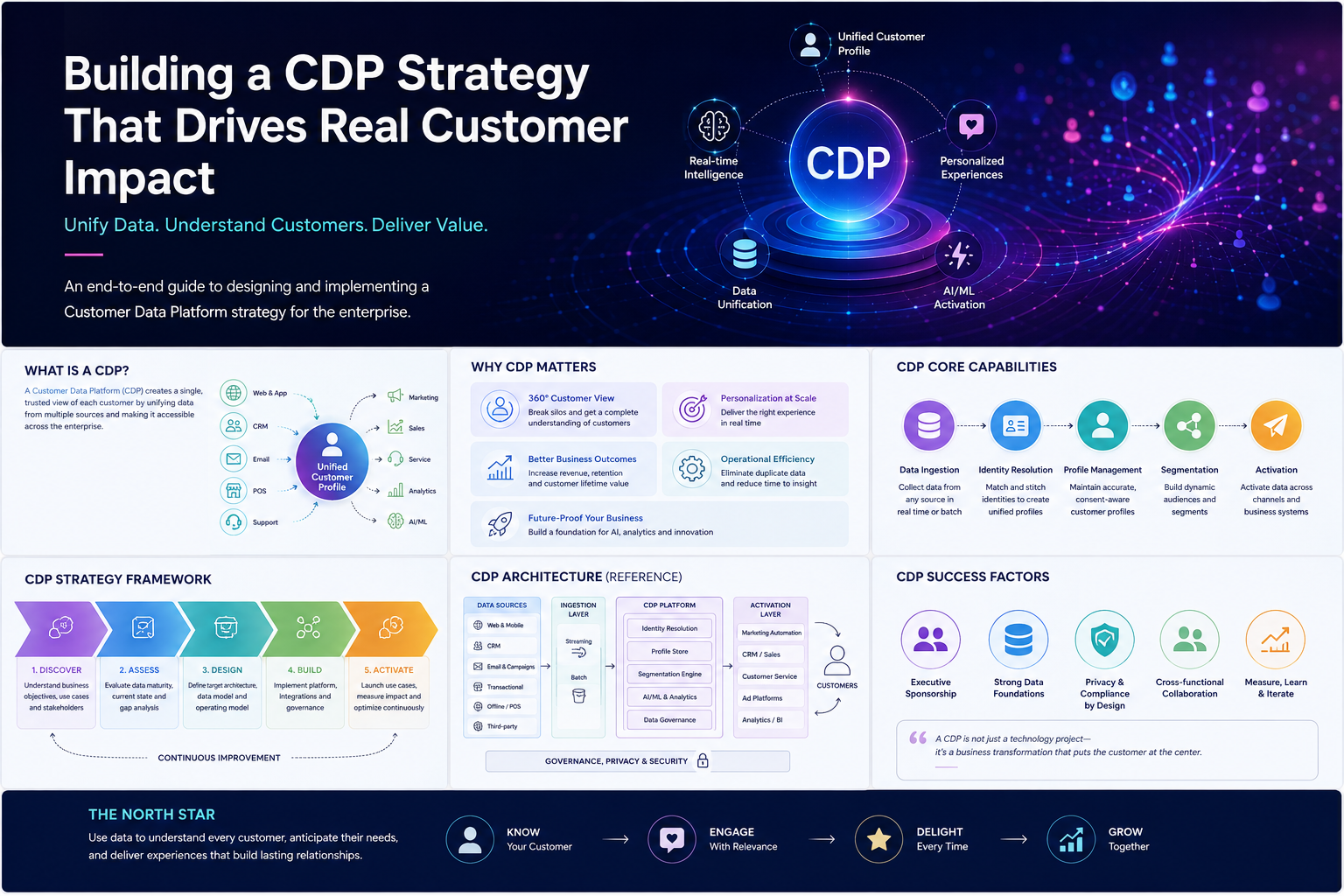
A Customer Data Platform (CDP) is “software that collects, unifies and organizes first-party customer data from multiple sources into a persistent, centralized database”, resolving identities across channels into single customer profiles usable for segmentation, analytics and activation. In practice, CDPs ingest data from websites, mobile apps, CRM systems, POS systems, email tools, call centers and other online/offline touchpoints, then stitch them together into a unified “Customer 360” record. This omnichannel, identity-resolved profile becomes the single source of truth for marketing, sales and service.
Unlike a CRM or data warehouse, a CDP emphasizes identity resolution and activation of data across marketing stacks. A CDP sits between systems: it ingests behavioral/transactional data (vs. CRM’s manually entered contacts or DMP’s anonymous ad data) and makes unified profiles available in real time to downstream tools. Critically, a “true” CDP (per the CDP Institute) must provide (1) marketer-friendly control (self-serve segmentation and journeys), (2) a persistent unified database (with de-duplication and historical retention), and (3) integration/activation (APIs, connectors to send the data to other systems). In short, a CDP collects and cleans fragmented data, resolves identities, and powers personalized experiences.
Types of CDPs
There are five broad CDP types. Each suits different architectures and use cases:
- Traditional CDPs: Packaged, all-in-one systems that host the data themselves. They provide end‑to‑end capabilities (data collection, identity stitching, segmentation, activation) in one proprietary platform. Examples include Segment, Amperity, Tealium. These are marketer-facing solutions.
- Composable (Warehouse-Native) CDPs: Modern CDPs that do not store data internally, instead working on top of your existing data warehouse or lake (e.g. Snowflake, Databricks). They use ETL/ELT pipelines and rely on your data infrastructure. Hightouch and Census are examples. They are flexible and quick to deploy but shift storage/Governance responsibilities to your data team.
- Hybrid CDPs: Combine the above: they have packaged features and can connect to an external data warehouse. They blend a proprietary CDP with compatibility to leverage an existing cloud data platform. ActionIQ is often cited as hybrid.
- Infrastructure CDPs: These are engineered for data teams (often open-source or platform-centric). They focus on data plumbing, event collection, streaming, and identity matching. Examples: RudderStack (open-source) and Segment’s underlying Delivery API. They require more engineering but offer flexibility.
- Marketing Clouds with CDP: Large suites from incumbents (Salesforce Data Cloud, Adobe RT-CDP, Oracle Unity). These bundle CDP capabilities with their CRM/marketing tools. They can be compelling for companies invested in that ecosystem but may be less flexible in multi-vendor stacks.
Each type has trade-offs (see [Vendor Comparison](#vendor-comparison)). The key is aligning type to needs: e.g. a purely cloud-native organization might prefer a warehouse CDP for speed, while a global CPG may lean on a robust packaged CDP for identity resolution and packaged connectors.
Why Deploy a CDP? Business Drivers and KPIs
Enterprises adopt CDPs to unlock value from first-party data. Key business drivers include:
- Personalization and Revenue Growth: Unifying data enables finely targeted campaigns. Forrester/McKinsey found that personalization leaders generate ~40% more revenue than average companies. With a CDP, marketers can leverage rich behavioral profiles to deliver product recommendations, dynamic content, and tailored offers. This relevance boosts conversion and AOV. For example, companies excelling at personalization see much higher engagement and sales.
- Improved ROI and Efficiency: By unifying customer lists, a CDP can prevent duplicate targeting and waste. One study notes that CDP-driven suppression of existing customers can reduce ad spend waste by 10–20%. CDPs also enable better lookalike seed audiences (improving ad ROI) and cross-channel frequency capping (reducing overspend). In practice, Wyndham Hotels reported a 60% lift in campaign conversions and 35% lower media costs after CDP-driven targeting. CDPs accelerate campaigns by enabling self-serve audience building, cutting lead time from weeks to minutes.
- Higher Customer Lifetime Value (CLV): Retaining and upselling customers costs far less than acquiring new ones. CDPs raise CLV by identifying churn risks early and surfacing upsell opportunities. They ensure a consistent experience across channels (ads, email, in‑store) so customers see coherent messaging. Improved retention and repeat purchases (and strong brand loyalty) flow from this consistency. KPIs here include higher repeat rate, larger basket size, and improved NPS.
- Faster Insights: CDPs democratize data. With ready segmentation tools, marketing teams no longer wait weeks for engineering reports. Queries like “who bought A but not B in the last 90 days?” can be answered in minutes via the CDP. Faster time-to-insight means more experiments per quarter and better optimization.
- Compliance and Trust: The privacy era is a major driver. CDPs centralize consent records and data lineages, making GDPR/CCPA compliance much easier. Instead of piecing together data from siloed systems, companies can honor data subject requests (DSARs) and opt-outs from one platform. This reduces regulatory risk and builds consumer trust. (Notably, CDPs can encode policies for new laws like India’s Digital Personal Data Protection Act alongside GDPR and CCPA.)
KPIs and Metrics: CDP success is measured by both marketing and operational metrics. Typical KPIs include:
- Marketing Metrics: Conversion rate, click-through rate, average order value, customer acquisition cost (CAC), return on ad spend (ROAS), and campaign revenue lift. For example, Wyndham tracked a $2.5M revenue gain and higher conversions.
- Customer Metrics: Retention rate, churn rate, churn-risk scores, CLV, NPS. A good CDP should enable measuring lift in repeat purchases or retention after personalization campaigns.
- Efficiency Metrics: Time-to-audience (days vs hours), number of segments created per month, reduction in duplicate profiles, IT hours saved on data requests. [27] recommends tracking engineering hours saved (less time merging data) and reduction in DSAR response time.
- Compliance Metrics: DSAR response time, percentage of customer data covered by consent records, number of audit findings. A CDP should shrink DSAR processing from days to minutes.
In summary, a CDP ties measurable improvements in revenue, cost savings, and compliance to the unification of data. As CDP vendor analyses note, businesses typically see gains in acquisition, retention and efficiency within a few months of deployment.
Key Stakeholders and Organizational Change
Implementing a CDP is a cross-functional initiative. Key stakeholders include:
- Marketing and Analytics Teams: Often champion the project. They define use cases (e.g. personalization, segmentation, campaign orchestration) and will be the day-to-day users of the CDP. Marketers look for self-serve tools (audience builders, journey builders).
- Data/IT Teams: Build and maintain the technical infrastructure. They integrate data sources into the CDP, set up identity resolution pipelines, and ensure data quality. They also manage CDP administration (data schema, connectors, API usage).
- Executives (CDO/CMO/CIO): Oversee strategy, budget, and alignment to business goals. They mandate CDP adoption, prioritize use cases, and ensure cross-department coordination. Their sponsorship is critical for change management.
- Privacy and Legal: Ensure compliance. They work on consent frameworks, data retention policies, and help configure the CDP’s privacy controls.
- Operations/Customer Support: Use the unified profiles for service (e.g. real-time data in support portals) and provide feedback.
Because CDPs touch many functions, organizational change management is crucial. This often means setting up a CDP steering committee (with marketing, IT, legal, etc.), assigning a CDP lead (Data Architect or CDP Manager), and training end-users on new workflows. Marketers may need training on self‑service analytics, while engineers need guidance on data ingestion pipelines and schema mapping. Cultural alignment (data-driven mindset, collaborative processes) is as important as technology. Enterprises should plan communication and education to avoid the pitfall of CDP being “another silo” – success comes when the CDP is embedded into the workflow of everyone from campaign managers to CX analysts.
Data Sources and Ingestion
A CDP’s value comes from ingesting all relevant customer data. Typical data sources include:
- Digital touchpoints: Website/app events, email interactions, ad platform data (Facebook, Google), social media engagement, mobile app data. These often arrive in real-time via APIs or event streams (e.g. Segment’s API, Tealium’s load rules).
- CRM and marketing systems: Contact details, lead scores, support tickets, email campaign logs from systems like Salesforce, HubSpot, Marketo, Zendesk. These may be pulled via batch exports or APIs.
- E-commerce and Point-of-Sale: Transaction records (order history, cart abandonments, loyalty program data) from platforms like Shopify, Magento, or in-store systems.
- Backend databases: User registrations, preferences, or 1st-party data collected (e.g. billing systems, subscription logs).
- Offline data: Call center logs, event attendees, in-person interactions (often ingested via batch files or middleware).
- Third-party enrichment (optional): If needed, firms sometimes append demographic or geolocation info, but a true CDP focuses on first-party data.
Ingestion methods: CDPs support multiple ingestion modes:
- Event Streaming: Many CDPs (Segment, Tealium, RudderStack) provide SDKs or tracking pixels to stream user events in real time. They often use Kafka/Kinesis or proprietary pipelines under the hood.
- Batch ETL/ELT: Data lakes or warehouses export tables to the CDP. For example, nightly loads of sales data from a database.
- APIs/Connectors: Pre-built connectors pull from SaaS (e.g. Salesforce CRM), or reverse-ETL pushes from the CDP to other systems.
- File Uploads: CSV/JSON exports loaded manually or via automation (e.g. marketing lists).
Regardless of mode, strong CDPs keep a detailed audit trail of data ingestion and respect consent flags. For instance, data marked as “do-not-track” upstream would be excluded from CDP processing.
“CDPs are omnichannel, gathering data from websites, mobile apps, CRM systems, point-of-sale platforms, email tools, and other online and offline touchpoints.” By stitching that data at the individual level, a CDP moves a company from fragmented customer views to coordinated, personalized engagement.
The first step is a data inventory: catalog all customer data sources, formats, refresh rates, and ownership. This informs the ingestion design (real-time vs batch, transformation needs, consent logic). A pilot may onboard a few key sources (e.g. web events + email) before scaling to everything.
Identity Resolution
Identity resolution is the heart of a CDP. It merges disparate records into unified customer profiles. Key concepts:
- Identifiers: Unique keys such as email, phone, loyalty ID, cookie ID, device ID. Deterministic matching uses exact IDs (e.g. matching on the same email).
- Probabilistic linking: When exact IDs are missing, CDPs apply algorithms to link records (e.g. matching by name, address, behavior patterns). Some use graph databases or ML models to infer that two profiles are the same person with a confidence score.
- Identity Graph: Many CDPs maintain a graph of identity relationships (household graphs, device graphs). For example, linking multiple devices and email addresses to one person.
- Merging logic: Business rules define how to merge attributes (e.g. newest update wins, or priority source). Historical records must also merge (maintaining a timeline of interactions).
- Golden Profile: The outcome is a “golden record” per customer, with a unique internal ID. All attributes (demographics, behavior, subscriptions) and interactions (events, transactions) are attached to this profile.
Strong identity resolution drastically affects ROI. For instance, New Look (UK retailer) found 3.4 million fragmented profiles and 31% of top customers used multiple email addresses. After using Amperity’s identity stitching, they could recognize and target high-value customers who were previously split across records. The business impact was huge: e.g. identifying 24% more high-value customers and boosting media ROI 50%.
Most CDPs resolve identities deterministically first (exact ID matches), then layer on probabilistic techniques. The process should be transparent (with dashboards showing match rates). Continuous matching is needed: as new data arrives, it should update or merge profiles.
A well-designed CDP’s identity model includes privacy safeguards (e.g. hashing emails, strict access controls). When merging profile data, compliance policies must apply (e.g. do-not-track flags, consent checks).
Data Model and Schema
Once data is ingested and identities resolved, the CDP must store it in a scalable data model. Common approaches:
- Profile table: Each row is a customer profile (unique ID) with key attributes (email, name, sign-up date, lifetime value, consent flags, etc.). This is the unified customer table.
- Event/Interaction table: A log of user events (web visits, purchases, email clicks). Each row includes a profile ID (foreign key), event type, timestamp, and event properties.
- Attribute tables: Sometimes profiles are split into segments like demographics, preferences, etc., normalized for flexibility.
- Session/Device table: If needed, CDPs may maintain current-session or device records linked to profiles (often for real-time use).
- Derived/Audit tables: e.g. a table of suppressed profiles (users who opted out) or audience lists.
Modern CDPs often adopt a schema-agnostic or flexible schema approach: they can ingest JSON events with arbitrary fields and incorporate them into the profile graph. However, when integrating with external systems (BI or warehouse), a consistent schema is valuable. Some enterprises define a master schema (e.g. Adobe’s XDM or the CDP Institute’s schemas) to standardize fields across channels.
Implementation note: Many CDPs automatically generate a canonical schema as data is ingested. Others allow custom data modeling (like mapping incoming fields to profile attributes). For a data engineer, it’s important to plan the schema upfront: decide on naming conventions, flatten vs nested structures, and retention of historical attributes.
Architecture Example: New Look’s implementation with Amperity and Databricks showcases how modern data stacks ease schema mapping. Their system processed over 7.5 billion records in minutes using a shared data lake, “without requiring complex schema mapping”, thanks to bidirectional data sharing between Amperity and Databricks. This kind of architecture (cloud data warehouse + CDP) can dramatically shorten implementation time.
Data Governance, Privacy and Compliance
CDPs are also governance platforms for customer data. Important considerations:
- Data Quality Governance: Establish processes for data cleansing, validation and normalization. Use the CDP to identify duplicates or anomalies (e.g. tools to detect outlier addresses or invalid emails). Implement data stewardship (assign owners for each data source).
- Consent and Privacy: A CDP should incorporate consent signals (opt-in status, channel preferences) into each profile. It must enforce these in downstream activations. As regulations multiply (GDPR, CCPA/CPRA, Brazil’s LGPD, India’s DPDP Act, etc.), organizations often centralize consent and preferences in the CDP.
- Auditability: The CDP provides an audit trail: which data was collected when and how it was used. This is crucial for answering Data Subject Access Requests (DSARs). A unified profile lets you respond in one place. Gartner notes that without a CDP, DSARs require querying many systems; with a CDP it’s “a single point of control”.
- Data Retention and Classification: Define how long to keep each data type (e.g. transactional data for 7 years, behavioral data for 1 year). The CDP can automate deletions or archiving. Also classify data sensitivity and apply encryption/segmentation (see Security).
- Privacy by Design: CDP solutions now often include built-in features: permission management dashboards, encryption at rest/in motion, pseudonymization/anonymization tools. For instance, Amperity and others explicitly highlight their compliance readiness.
“As privacy regulations multiply…managing consent and data governance across fragmented systems becomes exponentially harder. A CDP centralizes consent records, preference management, and data lineage into one auditable system.” This dramatically reduces risk: e.g. GDPR mandates a 72-hour breach notification and DSARs. With a CDP, responding to DSARs or deletions can be done instantly across all data, rather than chasing dozens of tools.
On compliance: don’t overlook regional laws. In an Indian context, the upcoming Digital Personal Data Protection (DPDP) Act will add requirements similar to GDPR. Ensure your CDP platform supports global compliance needs (granted, vendor contracts should clarify where data is stored, etc.).
Security Considerations
Security underpins the CDP. Typical measures include:
- Access Controls: Role-based access ensures only authorized users can view or manipulate data. For example, marketers may have profile-view rights, whereas raw data ingestion keys are limited to engineers.
- Encryption: Data should be encrypted both in transit (TLS) and at rest. Many CDPs use cloud providers’ encryption (AWS KMS, GCP’s envelope encryption, etc.).
- Network Isolation: For on-prem or private-cloud deployments, ensure VPC, firewalls, and private connectivity to on-prem sources.
- Monitoring and Auditing: The CDP should log all access and administrative actions. Look for anomaly detection (e.g. alerts on unusual data exports).
- Vendor Security: If using a SaaS CDP, review third-party attestations (SOC 2, ISO 27001) and data locality. Understand how the vendor handles backups, incident response, and vulnerability management.
Aerospike’s CDP primer emphasizes that CDPs “offer robust security measures to protect sensitive customer information. These platforms incorporate advanced encryption, access controls, and compliance to safeguard data… [and] provide tools for data anonymization, consent management, and audit trails”. In summary, treat CDP security on par with any enterprise data system: involve your CISO, perform threat modeling, and integrate CDP monitoring into your SIEM.
Integration with Martech, CRM, Analytics, and BI
A CDP’s power lies in activating unified data. Typical integration targets:
- Marketing Automation and Campaign Tools: Email platforms (Marketo, MailChimp), journey engines (Braze, Iterable), push notification services. The CDP should push segments or lists to these tools, or trigger campaigns directly via API.
- Advertising and Analytics: Ad platforms (Facebook, Google Ads, DSPs) for audience syncing. BI/analytics tools (Tableau, Looker) can query the CDP database or a connected warehouse for reporting. Many CDPs support reverse-ETL (sending segments to a data warehouse or analytics platform).
- CRM and Sales: Salesforce, Dynamics, etc. A CDP can feed a unified customer profile into CRM records, or surface lead scores to sales reps. Conversely, it can ingest CRM updates.
- Web & Mobile Personalization: CMS and front-end personalization engines (e.g. Adobe Target, Optimizely) via API calls. Real-time calls to the CDP can serve personalized content on websites/apps.
- Other Enterprise Systems: Loyalty engines, IoT platforms, call center software, chatbot/AI tools. Essentially any system that can consume customer data or produce relevant data.
In practice, integration is via a mix of built connectors and APIs:
- Connectors: Many CDPs come with 100+ pre-built connectors (webhooks, REST APIs, flat-file loaders). For example, a Salesforce connector might do hourly sync of contact data.
- Custom APIs: The CDP’s own API lets you read/write profiles and events programmatically. This supports real-time lookups for personalization or external triggers.
- Data Warehouses: Composable CDPs often sit directly on Snowflake/BigQuery. In those cases, BI and AI teams can query the same unified tables.
- Event Streams: CDPs can publish enriched events to Kafka or Google Pub/Sub for consumption by downstream systems (e.g. real-time ranking engines).
Key integration best practices:
- Decouple via APIs: Whenever possible, use APIs/webhooks instead of manual data dumps. This supports real-time activation.
- Data Contracts: Agree on data formats and schemas for each integration (for example, the fields in an exported “segment”).
- Testing and Monitoring: Validate that audiences sent to ad platforms match expectations. Monitor integration health (e.g. failed API calls).
- Govern Data Flow: Ensure integrations respect consent flags (do not activate data if opt-out). A “CDP activation policy” often enforces these rules centrally.
“A CDP does not exist in isolation. It must make unified customer data available to other systems, including marketing automation platforms, CRM systems, analytics tools, and ad networks… The value lies not just in storing data, but in operationalizing it across the enterprise.”
Thus, the integration strategy should be as carefully planned as the data strategy itself. During vendor selection and RFP, examine each CDP’s connector library, API limits, and ease of building custom integrations.
Real-Time vs Batch Use Cases
CDPs can power both real-time and batch applications, depending on architecture and needs:
- Real-Time Use Cases:
- Personalization & Recommendations: Displaying tailored content as a user browses (e.g. “customer 123 viewed shoes; recommend matching socks”). This requires millisecond-level profile lookup or event-stream processing.
- Ad Targeting and Suppression: Instantly syncing audience lists to ad platforms; preventing ads being shown to existing customers in real time. Some CDPs fire events to DSPs or adjust bidding on the fly.
- Trigger-Based Journeys: If a user’s behavior meets certain criteria (e.g. abandoned cart), an automated email or SMS is triggered immediately through the CDP.
- Fraud/Identity Alerts: In finance or gaming, a CDP might flag unusual patterns (login from new device + high-value order) and immediately notify fraud systems.
These use cases require streaming ingestion and immediate processing. Many CDPs have “real-time” engines or event bridges to support <1-second activations.
- Batch/Analytical Use Cases:
- Audience Building for Campaigns: At scale, you might run overnight or weekly jobs to build segments (e.g. “customers who purchased in last 90 days”).
- BI and Reporting: Daily or weekly sync of unified data into a data warehouse for in-depth analysis (attribution, lifetime value modeling, customer analytics).
- Regulatory Reporting: Periodic export of consent/logs for audits.
These can tolerate hourly or daily delays. Traditional ETL pipelines are suitable.
Most CDPs support hybrid modes. For instance, a CDP might ingest web events in real-time, update profiles on-the-fly, and let you query them via API, while also offering nightly full-database exports. Some vendors explicitly differentiate “Real-time CDP” (Adobe RT-CDP, for example) versus “batch-centric CDP” based on their architecture.
Suppression Example: A major benefit of real-time processing is ad suppression. A CDP can match CRM lists against ad audiences on the fly, ensuring you never pay to market to current customers. According to industry research, real-time suppression in prospecting campaigns “can reduce wasted spend by 10–20%”.
The choice of real-time vs batch depends on use cases: if instant personalization or messaging is critical, ensure your CDP solution supports streaming updates and low-latency lookups. If not, a warehouse-native CDP (batch-oriented) might suffice and be simpler/cheaper.
Architecture Options
Cloud vs On-Prem / Hybrid: Most modern CDPs are cloud-based SaaS (often multi-tenant on AWS/Azure/GCP). This offers rapid deployment and scalability. A few remain on-prem or private-cloud for sensitive industries (e.g. finance, government), but these are rare. Hybrid architectures mix: for example, data ingestion/processing happens on-prem, but the orchestration and profile engine run in the cloud.
Open-Source vs Commercial: Open-source CDPs (RudderStack, Snowplow, some components of Apache) give maximum control. You assemble data pipelines, user tables and activation logic yourself. This is flexible and cost-effective in licensing, but requires substantial engineering effort (and is essentially a DIY CDP). Commercial CDPs (Segment, Amperity, Tealium, etc.) provide turnkey features, vendor support, and faster time-to-value, at a licensing cost.
Warehouse-Native (Composable) CDPs: As noted, solutions like Hightouch or Census piggyback on your cloud data warehouse. Their architecture is essentially ELT pipelines plus reverse-ETL. This approach means no vendor data store – data lives in Snowflake/BigQuery. Advantages: you keep full control and can use your cloud’s elastic compute. Disadvantages: you need a mature data stack and data governance.
“Warehouse-native, or ‘composable,’ CDPs that build on existing cloud data platforms are gaining traction alongside traditional standalone systems”. This reflects the industry trend toward leveraging cloud data lakes as the ground truth.
Data Fabric / Lakehouse Integration: Some enterprises now integrate CDPs with big data architectures. For example, New Look’s solution combined Amperity (CDP) with Databricks. They ran identity matching and segmentation in Databricks on massive data sets. The result: processing over 7.5B records in minutes. The lessons: 1) CDPs can integrate with data lakes via connectors or direct queries, and 2) schema mapping can be automated in such a stack. In that case, implementation time was <90 days, demonstrating the efficiency of modern cloud CDP architectures.
Resiliency and Performance:
- Ensure high availability (SLA) if the CDP is mission-critical. Many vendors offer 99.9% uptime SLAs.
- Check scalability: how many profiles and events it can handle (billions of events/day are common for large retailers).
- For real-time use, evaluate the latency of profile reads/writes.
In summary, pick architecture according to scale, privacy needs, and existing infrastructure. A fully SaaS CDP is simplest; a warehouse-CDP is flexible; a data-fabric approach with CDP+data lake offers raw power for analytics.
Vendor Selection Criteria and RFP Checklist
Choosing a CDP vendor requires careful evaluation. Important criteria include:
- Use Cases Support: List your primary use cases (personalization, email targeting, analytics, etc.). Ensure the CDP excels in those. For example, if real-time journeys are key, test real-time API responsiveness. If B2B (account-based), ensure B2B profile support.
- Data Integration & Connectors: Depth of built-in connectors (CRM, ad platforms, email, e-commerce, etc.) and APIs for everything else. Look for both batch and streaming options.
- Identity Resolution Quality: How robust are the matching algorithms? Ask for match rates on sample data. Patented or advanced graph features are a plus.
- Segmentation & Activation: Does the CDP offer an intuitive segment builder? Can non-technical users create cohorts? How many destinations can audiences be sent to? Activation channels (email, ads, SMS) should align with your stack.
- Privacy and Governance: Built-in consent management, PII encryption, audit logs, easy deletion of profiles. Ensure compliance features (like opt-in capture) meet GDPR/CCPA/DPDP requirements.
- Analytics and AI: If you plan to use ML, does the CDP provide out-of-the-box analytics (e.g. RFM, propensity models) or machine learning tools? Or must you export data to an external ML pipeline?
- Usability: Since marketers often use CDPs daily, the UI/UX matters. Consider a usability trial.
- Scalability and Performance: Can it scale to your data volume? Ask about platform limitations (monthly tracked users, event volume, API rate limits).
- Support and Services: Vendor’s professional services for implementation, and ongoing support responsiveness. Look at case study outcomes (ROI, time to launch).
- Vendor Viability and Roadmap: How stable is the vendor? Are they growing (acquisitions, funding)? Do they innovate (AI, new integrations)?
A practical RFP checklist can be drawn from analyst advice:
- Use Cases: Define the business problems (e.g. unified customer 360, journey orchestration).
- Current Tech Stack: Inventory existing systems (CRM, data warehouses, analytics) and ensure compatibility.
- Stakeholders: Identify who will use and manage the CDP (IT, Marketing, Analytics) and get their input.
- Data Sources: List which data you need in the CDP (online, offline, transaction, etc.).
- Activation Destinations: List where data should go (email, ads, BI tools, etc.) to verify connector support.
- KPIs: Predefine how you will measure CDP success (to compare vendor benchmarks).
- Security & Compliance: Specify encryption, privacy and compliance requirements (GDPR, SOC2, etc.).
- Implementation: Request a high-level implementation plan or POC timeline from each vendor.
- Cost Structure: Understand pricing model (by number of profiles, events, or features). Collect ballpark quotes.
“Start with readiness and operational ownership, not features alone. Prioritize integration depth (connectors plus APIs/real-time pipelines), identity resolution strength, consent and compliance controls, usability for marketers, scalability and the ability to activate unified profiles…”. This counsel from industry analysts emphasizes that true business fit – not just feature checklists – should drive the decision.
Implementation Roadmap & Timeline
A phased approach is recommended for CDP roll-out:
- Strategy & Business Case (Month 0-1): Define objectives, success metrics, and use cases. Build the executive business case (ROI modeling). Get stakeholder buy-in and form the CDP team.
- Assessment & Planning (Month 1-2): Audit data sources, quality, governance. Document integration points and consent rules. Select a vendor (or plan DIY vs buy). Develop the overall architecture blueprint.
- Phase 1 – Pilot (Month 2-4): Implement a small-scale proof of concept. Ingest a subset of data (e.g. one channel like website events plus CRM). Configure identity resolution on this data. Test key features (e.g. run a simple campaign). Evaluate results and refine mapping or cleansing.
- Phase 2 – Core Deployment (Month 4-7): Ingest all major data sources (web, mobile, CRM, transactions). Build the unified profile model. Integrate key marketing/CRM systems. Conduct data validation and governance checks. Train initial power users.
- Phase 3 – Activation & Scale (Month 7-12): Launch first full campaigns (e.g. segment-driven email sends, real-time personalization). Expand user base (train wider marketing and analytics teams). Add secondary use cases (e.g. customer support view). Continuously monitor data flows and fix issues.
- Phase 4 – Optimization (Month 12+): Tune identity matches, refine segments with data science, and add advanced features (predictive modeling, AI-driven recommendations). Add new data sources (IoT, call center) over time. Regularly review KPIs to ensure ROI targets are met.
A timeline table might look like:
| Phase | Duration | Key Activities |
|---|---|---|
| Planning & Kickoff | 1–2 months | Align stakeholders, define use cases and KPIs, set up team. |
| Data Integration & Pilot | 2–3 months | Onboard select data sources, configure identity stitching, initial segment tests. |
| Core Implementation | 3–4 months | Ingest remaining data (online/offline), connect systems (CRM, email, ads). |
| Testing & Validation | 1–2 months | Verify data accuracy, fix issues, ensure compliance (DSAR tests). |
| User Onboarding & Launch | 2–3 months | Train users, roll out initial campaigns and real-time features. |
| Ongoing Optimization | Ongoing | Add features (AI models, new channels), scale to more users, review metrics. |
Case Example: In practice, modern CDP projects can be quite fast. For instance, New Look completed full Amperity+Databricks integration in under 90 days – faster than a conventional IT project – thanks to cloud data warehousing and pre-built CDP connectors. However, an enterprise-grade rollout with multiple stakeholders often spans 6–12 months to hit full scale.
Roles and Team
Successful CDP implementations typically involve:
- CDP Architect/Lead: Oversees the project end-to-end. Defines technical strategy, data models, and ensures alignment with business goals. Often a senior data engineer or solution architect.
- Data Engineers/Analysts: Build ETL pipelines, manage identity resolution code, load data, and maintain data quality.
- Marketing Lead/Campaign Manager: Defines segmentation logic, works on campaign setup, and acts as liaison between technical team and marketing.
- Project Manager: Keeps the timeline, coordinates between teams (IT, Marketing, Legal).
- Compliance Officer/Data Privacy Lead: Advises on regulatory requirements, reviews the CDP’s privacy design, and oversees consent management.
- Executive Sponsor: A CMO or CDO who provides funding and executive backing.
Many organizations also engage external consultants or system integrators experienced in CDP deployments (especially for complex migrations). As Central Group’s case showed, bringing up an in-house team vs hiring an SI can be a trade-off: Central Group opted to build internally (saving SI fees, though with a steeper initial learning curve).
Cost Considerations
CDP pricing varies widely by vendor and scale. Key drivers are: number of monthly tracked users (profiles), volume of events, features (real-time vs batch, AI modules), and professional services. According to industry benchmarks, “for the most basic version of a CDP, you can expect to pay between $50,000 and $150,000 annually”; enterprise needs with higher data volumes can run into hundreds of thousands or even millions of dollars per year.
Some cost models:
- Flat fee: Covers a tier of features and usage (common in large SaaS bundles like Salesforce/Adobe).
- Profiles-based: Charged per active profile (often per million users).
- Events-based: Pay per volume of tracked events or API calls (common in Segment/RudderStack).
- Usage-based (resource): Especially for warehouse-CDPs, fees can correlate with compute hours or storage (e.g. per-GB processed).
- Add-ons: Premium features (real-time API, AI modules, extra connections, SLAs) often cost extra.
- Services: Don’t forget consulting or implementation partner fees, which can be 20–50% of software cost in the first year.
When budgeting, factor in total cost of ownership: software, cloud infrastructure (if self-hosted), implementation/consulting, and ongoing maintenance. Also consider hidden savings: in-house consolidation of solutions (DMPs, marketing clouds) may reduce other license fees once the CDP is in place.
Success Metrics and ROI
Defining success metrics upfront is crucial. Beyond revenue lift and cost savings (discussed above), consider:
- Adoption Metrics: Number of active users/teams on the CDP, number of segments created, self-service usage rates (e.g. how many campaigns launched through CDP audiences vs manual lists).
- Data Quality Metrics: Percentage of merged profiles (vs anonymized/unknown), reduction in duplicate records, and percentage of data sources fully integrated.
- Performance Metrics: Time to onboard new data sources, query latency, API uptimes.
- Optimization Metrics: Percentage reduction in manual queries to data warehouse (time saved for analysts), improvement in DSAR handling time (e.g. from days to minutes).
- Business Impact Metrics: As noted, conversion lift, ROAS, retention rate improvements, increased cross-sell rate, or even the incremental revenue directly attributed to campaigns powered by CDP segments.
It can help to quantify ROI by relating improvements to dollars. For example, if you know your email campaign yields 2% conversion normally, a 60% lift as Wyndham saw should translate to a concrete revenue increase given your volume.
Frameworks often compare pre-CDP baseline vs post-CDP performance on key metrics (as [32†L300-L310] suggests). Keep good analytics to attribute changes accurately.
Common Pitfalls and Mitigation
- Unclear Use Cases: Don’t “buy a CDP for the sake of it.” Avoid generic goals. Mitigation: Start with 2–3 well-defined use cases and pilot them.
- Data Quality Issues: Garbage in = garbage out. Mitigation: Spend time cleaning and deduplicating critical data before or during ingestion.
- Overcomplicating Identity: Too many ID sources or incorrect match logic can muddy profiles. Mitigation: Begin with deterministic keys (emails, IDs) and progressively add probabilistic matching, monitoring results.
- Siloed Ownership: If marketing and IT don’t collaborate, the CDP can become a Frankenstein. Mitigation: Form a joint steering group and define clear responsibilities.
- Underestimating Effort: Integrating legacy systems and wrangling data is often bigger work than expected. Mitigation: Buffer timeline for unforeseen data onboarding challenges.
- Security/Privacy Overlook: Starting integration without review can lead to noncompliance. Mitigation: Involve privacy teams from day one and leverage the CDP’s compliance features.
- Lack of Governance: Without governance, the CDP can become unmanageable. Mitigation: Establish data governance policies (naming conventions, retention rules, access controls) early.
Being aware of these pitfalls and having a mitigation plan will smooth implementation. As one source notes, a CDP can fail if teams don’t build a clear business case or if data engineers feel it duplicates their data warehouse – address both technical and organizational concerns upfront.
Sample Governance Policies
Example policies you might define for CDP data:
- Data Access Policy: Only marketing users can query certain profile attributes; only engineers can modify identity matching rules.
- Data Retention Policy: Keep raw event data for 2 years, anonymize older events; permanently delete records of unsubscribed users after 30 days.
- Consent Policy: Store consent timestamps for each channel; do not activate any profile unless at least one required consent is recorded. Flag and remove profiles on a do-not-contact list immediately.
- Data Classification: Label PII vs non-PII. All PII fields (email, phone) are encrypted and have stricter audit logs.
- Change Management: Any changes to identity rules or data ingestion (e.g. new source) must go through a review board to assess impact on existing profiles and KPIs.
These policies should be formalized (often within the CDP settings or an attached data catalog). Refer to legal/regulatory requirements when drafting them.
Data Model Example
A very simplified data model for illustration:
Customers_Profile
-----------------
customer_id (PK)
email, phone, name, date_of_birth, loyalty_member_flag, email_opt_in, created_at, updated_at

Web_Events
----------
event_id (PK)
customer_id (FK to Customers_Profile)
timestamp, page_url, event_type

Purchases
---------
purchase_id (PK)
customer_id (FK)
timestamp, order_value, items, product_ids

Email_Engagements
-----------------
engagement_id (PK)
customer_id (FK)
campaign_id, open_count, click_count, last_sent
In this model, customer_id is the CDP’s internal unified ID. Every event or transaction table joins to it. In practice, the CDP may maintain these tables (in its own store or in a connected warehouse) and automatically update them when new data arrives.
Sample SQL/Pseudocode
Identity Stitching: (Join events to profiles by common identifiers)
-- Example: link web events to customer profiles
SELECT
  COALESCE(p.customer_id, e.anonymous_id) AS unified_customer_id,
  COALESCE(p.email, e.email) AS email,
  e.page_url, e.event_type, e.timestamp
FROM Web_Events AS e
LEFT JOIN Customers_Profile AS p
  ON e.email = p.email
     OR e.device_id = p.device_id;
This pseudocode demonstrates matching by email or device ID. (In reality, probabilistic logic might be applied in code rather than pure SQL.)
Segmentation Query: (Simple segment of high-value recent customers)
-- Select customers with a purchase > $1000 in the last 90 days
SELECT customer_id
FROM Purchases
WHERE timestamp >= DATE_SUB(CURRENT_DATE, INTERVAL 90 DAY)
  AND order_value > 1000
GROUP BY customer_id;
This identifies customers who spent more than 1000 in the past 3 months. The CDP can load this result as a segment for a campaign.
(Note: Actual CDPs often have UI segment builders, but knowing the underlying query is useful for data teams.)
Vendor Feature and Cost Comparison
| Vendor/Platform | Category | Highlights / Features | Pricing (approximate) |
|---|---|---|---|
| Twilio Segment | Traditional CDP | Early market leader; strong event collection and pipeline; supports warehouse sync (reverse ETL); excellent integration ecosystem. | ~$50K–$150K+ per year (usage-based) |
| Amperity | Traditional CDP | Focus on advanced identity resolution and AI modeling; rich CPG/retail case studies (Wyndham, New Look); scalability on big data. | Enterprise-tier pricing (high-end) |
| Tealium (AudienceStream) | Traditional CDP | Integrates with Tealium iQ Tag Management; real-time data collection; robust event/attribute stitching; large connector library. | Enterprise pricing (not publicly listed) |
| Salesforce Data Cloud | Marketing Cloud | Built on Salesforce platform (Snowflake backend); seamless with Salesforce CRM and Marketing Cloud; AI features via Tableau CRM. | Subscription included with SF licenses; high-end |
| Adobe Real-Time CDP | Marketing Cloud | Part of Adobe Experience Platform; deep integration with Adobe Marketing Cloud (Analytics, Campaign); strong real-time profile and segment builder. | Bundled with Adobe AEP; enterprise pricing |
| mParticle | Traditional CDP | Mobile and SDK specialization; strong in media/e-commerce; recently added warehouse integrations (reverse ETL). | Custom quotes (mid-market enterprise) |
| Treasure Data | Traditional CDP | Big-data roots; extremely scalable (used by large enterprises); strong analytics and data science tools; also offers streaming and batch. | Usage-based; enterprise tier for large data |
| RudderStack | Infrastructure CDP | Open-source core with cloud offering; pipeline-centric (Kafka/Kinesis); ideal for data engineering teams; offers free tier (250K events/mo). | Free tier; paid starts ~$220/mo for 1M events |
| Hightouch | Composable CDP | Reverse-ETL only (no data storage); for teams with a cloud warehouse; fast to set up; integrates with Snowflake/BigQuery/Redshift. | Freemium + tiers; quotes for enterprise |
| ActionIQ | Hybrid CDP | Mature customer intelligence platform; strong segmentation and orchestration; recent focus on warehouse integration. | Enterprise pricing |
Sources: Vendor literature and industry analyses. Pricing is illustrative. Actual costs depend on data volume and feature needs.
Implementation Roadmap and Phases
Below is a phase-by-phase timeline for a typical CDP rollout (adjust durations to your scale):
| Phase | Duration | Key Activities |
|---|---|---|
| 1. Strategy & Design | 1–2 months | Align business use cases; define success metrics; finalize architecture; select vendor/approach. |
| 2. Data Preparation | 2–3 months | Audit and cleanse data; set up ingestion pipelines for key sources (web, CRM, etc.); define identity schema. |
| 3. Pilot Deployment | 2–3 months | Onboard a subset of data; configure identity matching; create initial segments; run test campaigns; validate data. |
| 4. Full Rollout | 3–6 months | Scale ingestion to all sources; connect marketing and BI systems; train teams; launch real campaigns. |
| 5. Optimization & Growth | Ongoing | Add new use cases (AI/ML, new channels); refine models and governance; measure ROI and iterate. |
Case in point: New Look’s fashion retail CDP project achieved full integration (spanning 7.5B records) in under 90 days by leveraging a modern data stack. This illustrates that a cloud-based CDP can be implemented far quicker than traditional enterprise IT projects.
The roadmap should be adaptive. It’s wise to build quick wins early (e.g. one high-impact segment or campaign) to demonstrate value and gain momentum. Throughout, maintain clear project governance and keep stakeholders updated on progress.
Enterprise Case Studies
Wyndham Hotels & Resorts (Hospitality): Wyndham needed a unified view of loyalty and non-loyalty guests to boost direct bookings. Their old system lacked a “single source of truth”, so segments and targeting were inaccurate. By onboarding Amperity CDP (on AWS), Wyndham built unified guest profiles. The results were swift: within a month, 90% of their digital media budget was deployed through Amperity-driven audiences, and they saw a 60% increase in conversion rates, a 35% drop in media costs, and $2.5M in annual new revenue. As Wyndham’s CMO put it, Amperity unlocked a “complete 360 guest view… [enabling] more timely, efficient and effective… engagement”. Wyndham’s case highlights how a CDP can quickly translate into double-digit ROI when marketing is empowered with accurate data.
Central Group (Retail, Thailand): Central Group, a large Thai retailer, unified their fragmented online/offline data using Twilio Segment. They built a robust CDP integration in-house. With it, they implemented dynamic Recency-Frequency-Monetary (RFM) campaigns: segmenting recently churned customers and reactivating them. The impact was a 10× increase in revenue from these reactivation campaigns, something they say “would not be possible without Segment’s capability”. They also liberated marketing from IT bottlenecks: what used to take weeks to extract was now minutes. Central Group’s story illustrates both technical and organizational lessons: they saved cost by building internally (forgoing a system integrator) and leveraged the CDP for dozens of use cases (over 80 segments). It underscores that with a strong CDP, advanced analytics (like AI recommendations) become feasible, driving competitive advantage.
These cases (and others from media, financial services, etc.) consistently report that better data (unified profiles) leads to better marketing and business outcomes. They also remind us: success depends on clear goals, cross-team alignment, and measuring impact.