The Paradigm Shift: From Reactive Assistance to Autonomous Execution
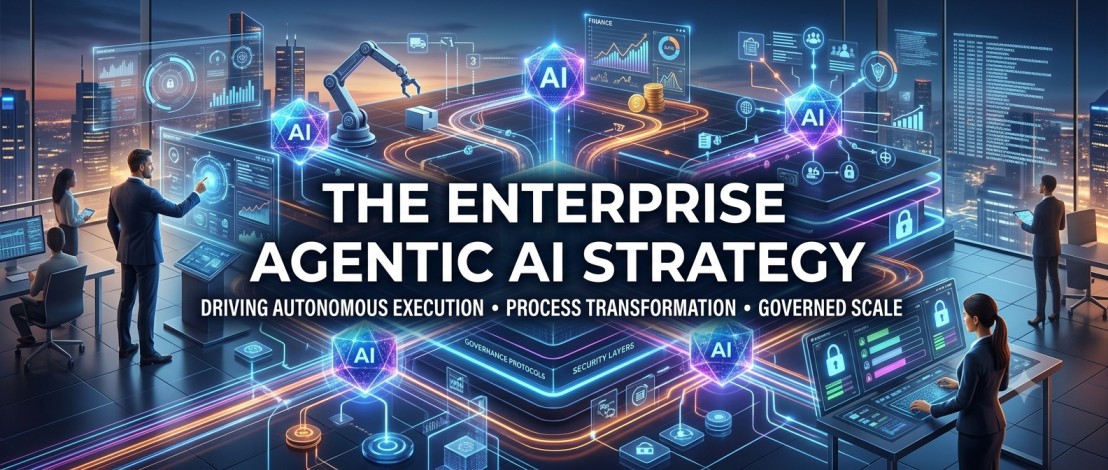
While the initial wave of generative artificial intelligence focused on prompt-dependent assistance - such as semantic search, content generation, and chat-based copilots - the frontier of enterprise value creation centers on Agentic AI. These advanced architectures operate as goal-driven entities that perceive complex corporate environments, decompose high-level objectives into sequential execution paths, invoke enterprise application programming interfaces (APIs), and dynamically self-correct based on operational outcomes.
This capacity for adaptive, probabilistic decision-making marks a clean break from traditional robotic process automation (RPA). Traditional RPA relies on rigid, deterministic rules that fracture when encountering minor data variations, system updates, or process edge cases. Conversely, agentic systems utilize large language models (LLMs) as cognitive reasoning engines. This allows them to navigate process ambiguity, re-evaluate approaches in real time, and securely coordinate workflows that span multiple disconnected business applications.
To capitalize on this transformation, enterprises must move past fragmented, ad-hoc agent deployments and adopt a structured, scale-ready operating model. Management consulting frameworks indicate that the organizations capturing the highest returns from AI scale their initiatives by prioritizing a balanced allocation of resources: 10% on algorithmic selection, 20% on technology and data engineering, and 70% on business process re-engineering and human capital alignment.
BCG 10-20-70 Allocation Rule
Rather than deploying isolated tools, forward-looking enterprises leverage three interconnected value plays to scale their systems: deploying immediate productivity solutions, reshaping end-to-end business operations, and inventing entirely new business models. Data from AI-mature organizations reveals that 72% of realized AI value is generated within core business functions such as operations, marketing, sales, and supply chain management. Transitioning to an agentic paradigm is not merely a software upgrade; it is a fundamental redesign of how the modern enterprise operates, coordinates, and governs its digital workforce.
Enterprise Agentic Use Cases and Industry Case Studies
Enterprise AI agents are transitioning from isolated experiments to scaled production environments, driving structural efficiency across multiple industries. By analyzing telemetry, transaction patterns, and unstructured records, these agents execute complex workflows while elevating human workers to strategic oversight roles.
Touchpoint elimination
Customer retention
Immutable audit logs
Intelligent Process Orchestration in Procurement
Traditional procurement processes are frequently slowed down by manual budget verification, complex routing rules, and exception-handling delays. By integrating autonomous agents directly with ERP, CRM, and human resource information systems (HRIS) via secure APIs, enterprises are automating these administrative workflows.
An execution pattern deployed within global manufacturing organizations involves an orchestration agent that automatically ingests purchase requests, validates them against cost-center budgets, routes them based on authorization levels, and manages exceptions - such as assigning alternative approvers when primary personnel are out of office. This deployment pattern has delivered a 32% reduction in procurement cycle times (shortening processes from 12 days to 8 days) and eliminated 68% of manual approval touchpoints, driving overall SLA compliance from a 71% baseline to 94%.
Predictive Maintenance and Industrial Operations
In asset-heavy industries, unscheduled downtime directly impacts profitability and operational resilience. Autonomous agents resolve this by ingestings live asset telemetry and IoT sensor data to detect failure patterns before physical breakdowns occur.
When an anomaly is flagged, the agent dynamically schedules maintenance during low-production windows, queries inventory systems for replacement parts, and coordinates work orders within the enterprise asset management system. In logistics and rolling stock maintenance, operators like Switzerland's national railway operator (SBB) have digitized fleet maintenance by integrating AI and spatial computing, achieving ambitious cost, reliability, and fleet availability targets.
Supply Chain and Inventory Optimization
Modern supply chains are highly vulnerable to localized disruptions, demand spikes, and shipping bottlenecks. Autonomous agents redefine supply chain management by providing continuous, high-frequency monitoring and automated execution.
Using probabilistic reasoning rather than rigid rules, supply chain agents dynamically analyze inventory positions, sales rates, and weather disruptions. If a stockout risk is detected, the agent identifies alternative suppliers, runs a cost-benefit calculation on expedited shipping, and automatically issues a purchase order within predefined spending limits. Industry projections indicate that by 2030, 50% of cross-functional supply chain solutions will leverage intelligent agents to execute autonomous decisions. Scaled implementations, such as those deployed by global industrial goods manufacturers, have unlocked unprecedented supply chain agility and resilience, delivering a 2 percentage-point EBITDA boost within a 24-month window.
Automated Medical Writing in Biopharmaceuticals
The clinical trial and regulatory approval process in biopharmaceuticals is exceptionally document-intensive, requiring extensive medical writing that often delays product launch timelines. To accelerate this, global pharmaceutical organizations have integrated specialized writing agents to automate the draft and assembly of clinical study reports and regulatory filings. By accessing clinical trial databases, structuring patient telemetry, and drafting compliance-ready summaries, these agents have drastically shortened development timelines, enabling therapies to reach clinical markets faster while maintaining regulatory compliance.
The following matrix outlines the operational metrics, realized impacts, and strategic value of these deployments across key industry sectors:
| Industrial Sector | Core Agentic Use Case | Operational Performance Indicators | Realized Strategic Value |
|---|---|---|---|
| Global Manufacturing | Intelligent Process Orchestration & Procurement. | 32% reduction in purchase approval cycle times; 68% decrease in manual approval touchpoints. | Escalation of policy violations only; automated routing of routine approvals to achieve 94% SLA compliance. |
| Biopharmaceuticals | Medical Writing and Regulatory Documentation. | Comprehensive drafting of clinical study reports; validation of clinical data sets. | Accelerated regulatory filing timelines, reducing time-to-market for critical therapeutic drugs. |
| Industrial Goods | Supply Chain Logistics & Fleet Maintenance. | High-frequency inventory rebalancing; automated vendor negotiation. | Unlocked operational agility, optimized distribution paths, and delivered a 2% EBITDA margin expansion. |
| Railway Logistics | Predictive Train Fleet Maintenance. | Continuous telemetry analysis of rolling stock; automated maintenance scheduling. | Enhanced fleet reliability, minimized unscheduled downtime, and reduced maintenance costs. |
| Customer Success | Autonomous Churn Prevention & Retention. | Immediate context-aware dispute resolution; continuous account monitoring. | Delivered an 11:1 cost-to-value ratio by preventing high-value customer churn at scale. |
Architectural Blueprint: The Managed Agent Runtime
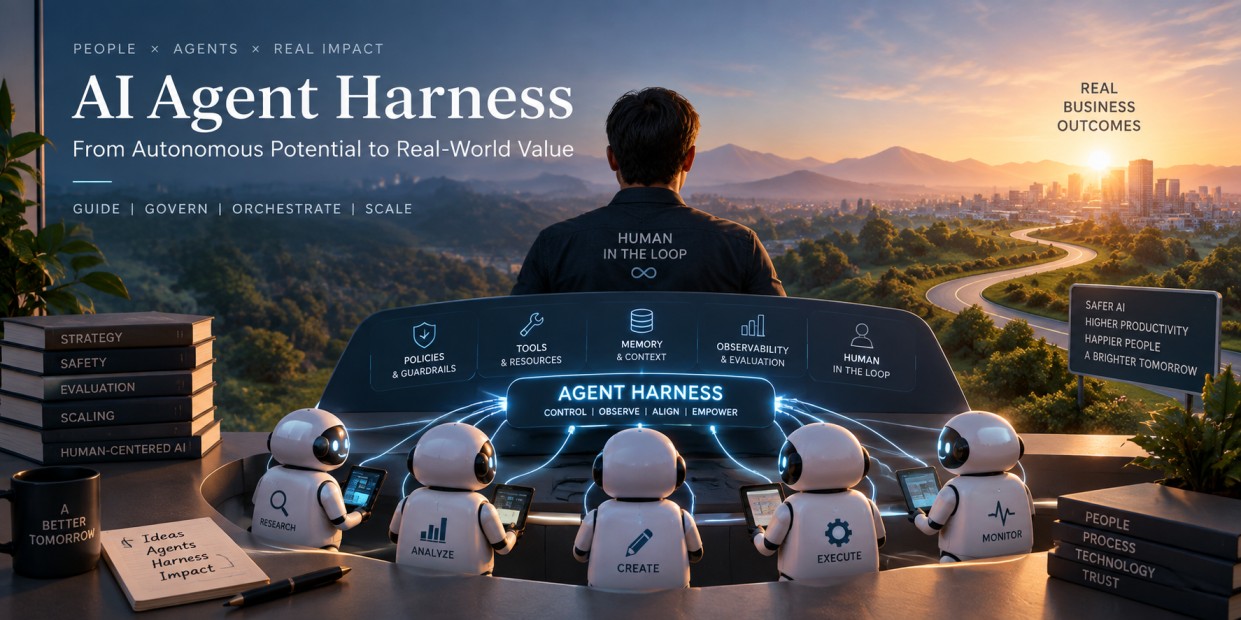
To scale agentic capabilities without introducing technical debt, enterprises must move away from application-specific agent implementations. Developing customized orchestration, memory, and tool integration layers for every individual application results in duplicated effort, fragmented controls, and an unmanageable security posture. The solution is standardizing on a unified Managed Agent Runtime (previously referred to as the Enterprise Agentic Harness).
The Managed Agent Runtime serves as an in-network execution and governance layer that securely binds raw cognitive model intelligence to core enterprise systems of action, data, and memory. It provides a standardized control plane that manages agent identities, enforces data boundaries, orchestrates system tools, and captures complete audit trails.
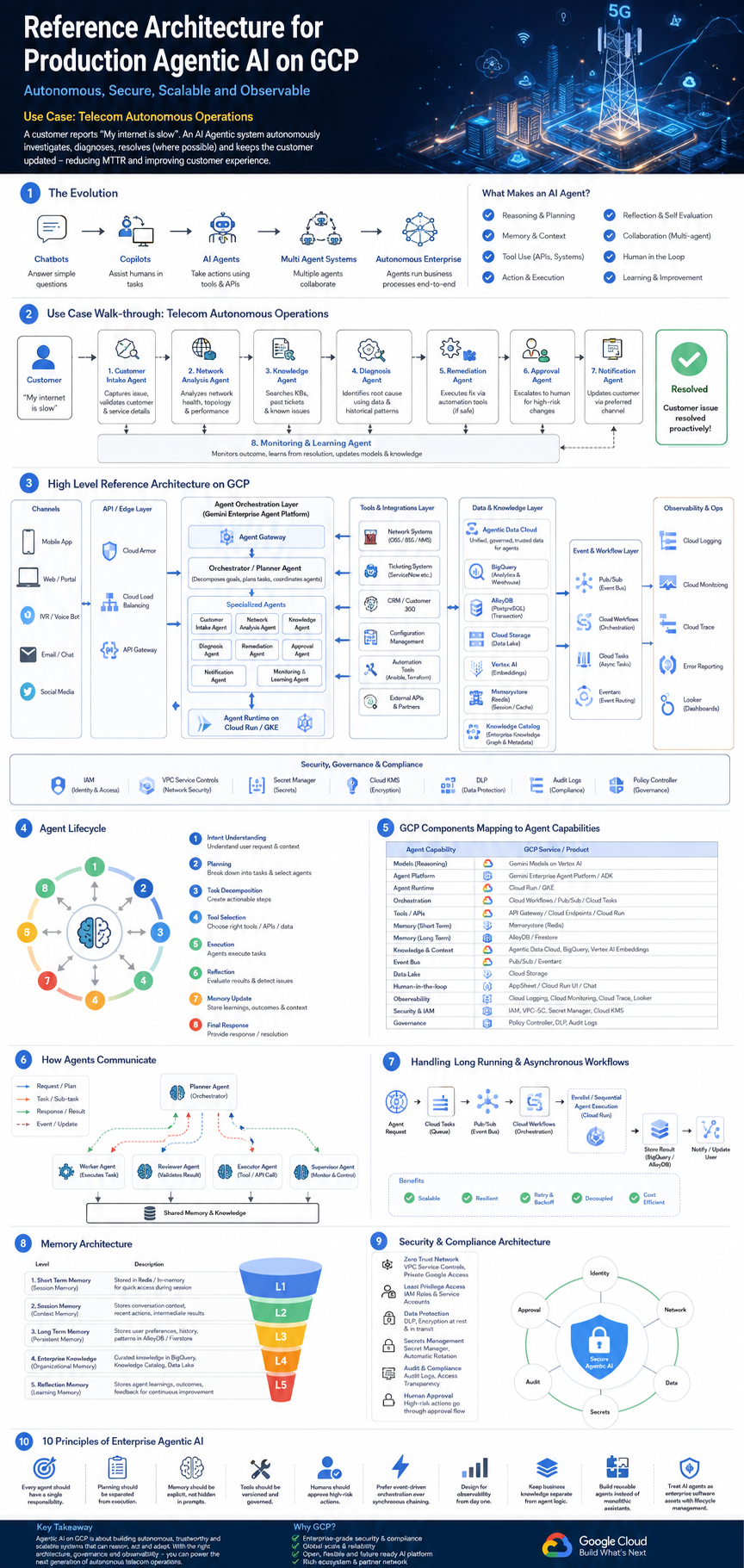
The runtime is structured into ten modular, complementary architectural layers:
Interface and Ingress Layer
Normalizes unstructured requests from diverse entry channels (e.g., corporate chat applications, ERP event streams, external APIs) and enriches them with tenancy, operational priority, and identity context.
Session and State Management Layer
Manages persistent state histories across long-running, interrupted, or multi-step execution windows, ensuring the agent can resume a workflow after awaiting human approval or system events.
Orchestration and Control Loop
The core coordinator of the runtime, balancing adaptive reasoning steps with deterministic business validation rules.
Model Abstraction Layer
Decouples agents from specific model providers, dynamically routing requests across models (such as GPT-4, Claude 3, or Llama 3) based on cost, context window, latency, and compliance requirements.
Tool Execution Layer
Acts as a governed action mediator, ensuring that any external tool call or database query is validated for schema compliance, checked for authorization, and run within predefined rate limits.
Context and Memory Layer
Structures and retrieves domain knowledge, assembling vector store embeddings, transaction histories, and business ontologies to present the model with a grounded state.
Environment and Runtime Layer
Provides secure, isolated execution sandboxes (such as secure enclaves or containerized microservices) where code generated by agents can safely run without exposing the broader infrastructure.
Safety and Governance Layer
Enforces real-time behavioral boundaries, screening agent intents for prompt injections, data loss prevention (DLP) violations, and regulatory compliance breaches.
Observability and Evaluation Layer
Captures immutable, step-by-step execution logs, recording every prompt, tool call, evaluation output, and human-in-the-loop decision for post-execution auditability.
Extension Surface Layer
Exposes modular integration interfaces, allowing developers to build custom adapters, domain tools, and memory connectors without altering the core runtime.
Inside this runtime, the operational lifecycle of an agent relies on three core architectural pillars: Layered Memory Systems, Multi-Stage Planning Mechanisms, and Tool Orchestration Layers.
Memory Systems: To prevent system degradation, memory must be tiered. Working Memory tracks the immediate, temporary state of the active task, whereas Persistent State manages durable checkpoints and workflow history across separate execution sessions. High-density context is stored externally in vector databases and retrieved dynamically via embedding-based lookups.
Planning Mechanisms: Agents transition from raw, unstructured generation to systematic planning. A high-level planner decomposes a primary goal into a series of structured subtasks. Domain coordinators assign these subtasks to specialized execution agents, while a centralized controller monitors progress, manages exceptions, and dynamically reformulates the plan if execution outcomes diverge from expected results.
Tool Orchestration: The runtime manages how agents interact with external resources by executing a structured loop: identify the target action, select the authorized tool, pass schema-validated arguments, execute the sandboxed call, capture the system response, and update memory.
To optimize resource allocation, the platform architecture must be built to be "composable and compostable" - reusing standardized components while remaining modular enough to quickly swap out individual modules as technology evolves. Decisions to build, buy, or partner across these layers must be governed by a clear strategic framework:
| Architecture Layer | Sourcing Decision | Technical Execution Strategy | Strategic Rationale |
|---|---|---|---|
| Model Abstraction & API Access | Buy. | Standardize on enterprise-grade cloud API platforms (e.g., Azure OpenAI, AWS Bedrock, Google Cloud). | Eliminates infrastructure maintenance overhead and shields the enterprise from model provider lock-in. |
| Tool Execution & Sandboxed Enclaves | Partner / Buy. | Integrate with established container orchestration platforms and API gateways. | Leverages robust, industry-standard infrastructure to securely isolate code execution and manage secrets. |
| Orchestration, Memory & Context Routing | Build (Selectively). | Assemble modular systems using open-source frameworks, anchoring them to proprietary enterprise data. | Keeps core business logic and context routing within the enterprise boundary, securing a custom operational advantage. |
Protocol Standardization and Multi-Agent Orchestration
As enterprises scale agentic networks, interoperability and secure communication become paramount. Without standardized communication protocols, organizations face integration gridlock, with individual departments building incompatible agent systems that cannot share data or hand off workflows. To solve this, the enterprise architecture must mandate the adoption of two emerging connectivity standards: the Model Context Protocol (MCP) and the Agent-to-Agent (A2A) Protocol.
MCP provides a structured, secure, and bidirectional communication layer between models and external resources (such as live databases, code repositories, SaaS APIs, and local file systems). Instead of hardcoding custom integration adapters for every agent, MCP establishes a standardized model for how agents discover available tools, query enterprise data sources, and receive schema-enforced inputs. This protocol ensures that access permissions and data security policies are enforced at the data source boundary before the agent can retrieve or modify information.
Complementing MCP, the A2A protocol defines the rules for how autonomous agents coordinate, delegate tasks, and exchange workflow states across separate systems. A2A allows agents built on different foundational models or provided by different software vendors to securely collaborate. By standardizing how agents authenticate each other, pass task contracts, and resolve conflicting outputs, A2A prevents vendor lock-in and enables a distributed, enterprise-wide ecosystem where specialized agents can run in parallel.
The Enterprise Agentic AI North Star Architecture
To successfully move from experimental, prompt-driven pilots to production-ready digital operations, enterprise architects must transition to an integrated Tri-Plane Reference Architecture. This blueprint separates probabilistic cognitive reasoning from deterministic system integration, creating a scalable control layer that ensures safety, reliability, and security across the enterprise.
Inside this architecture, responsibilities are cleanly divided into four distinct operational planes:
1. The Reasoning and Cognition Plane
This layer serves as the primary intelligence engine, housing foundational LLMs and cognitive libraries. It interprets unstructured user inputs, translates high-level corporate objectives into actionable roadmaps, and determines task delegation paths. Rather than executing tasks directly, this plane generates structured intents and specifies which specialized skills or tools are required to achieve the goal. It manages the dynamic control loop of perception, reasoning, and planning, ensuring that complex tasks are broken down into solvable subtasks.
2. The Control Plane
Acting as the central governance, security, and administrative hub of the ecosystem, the Control Plane sits between intelligence and action. It acts as a deterministic firewall, preventing models from interacting directly with raw databases or executing unsafe commands. Built on the Model Context Protocol (MCP) and open-standard identity systems, this plane validates tool schemas, checks agent credentials (e.g., Entra Agent IDs), enforces rate limits, and dynamically evaluates real-time security policies. It also coordinates the Agent Mesh, enabling specialized peer-to-peer delegation and orchestrating execution workflows.
3. The Execution Plane
This layer comprises the enterprise environments where physical transactions, software changes, and analytical processes actually run. The execution plane isolates agent-generated actions within secure, containerized sandboxes, virtual machines, or isolated enclaves. It interfaces directly with systems of record (e.g., SAP, Salesforce, Oracle ERP), external SaaS APIs, local file systems, and traditional robotic process automation (RPA) tools.
4. The Data and Grounding Plane
The informational bedrock of the entire system, this plane brings AI directly to enterprise data to eliminate synchronization delays and "decision lag". It houses vector databases, enterprise knowledge graphs, and semantic memory networks. The Data Plane provides real-time contextual grounding, structures schema discovery for the reasoning engine, and dynamically secures access control at the data-source boundary to prevent unauthorized exposure.
The following table contrasts the functional profiles, key components, and integration parameters across these operational planes:
| Operational Plane | Primary Functions | Key Architectural Components | Systems Integration Point |
|---|---|---|---|
| Reasoning Plane | Intent interpretation, task planning, self-correction. | Foundation LLMs, cognitive libraries, planning logic. | Model APIs. |
| Control Plane | Policy enforcement, schema validation, identity management. | MCP servers, agent registries, access gateways. | API Gateways, IAM (Entra). |
| Execution Plane | Task resolution, code execution, database writes. | Isolated sandboxes, API connectors, RPA scripts. | ERP, CRM, Core SaaS. |
| Data Plane | Real-time grounding, vector indexing, schema discovery. | Vector stores, context databases, knowledge graphs. | SingleStore, SAP HANA, Azure Purview. |
Enterprise Governance, Zero-Trust Security, and Agentic GRC
Integrating autonomous agents into production environments fundamentally changes the enterprise threat landscape. Standard security frameworks assume that system access requests are initiated by human users or static, predictable system services. Agentic AI systems disrupt this paradigm by generating complex, multi-step execution requests at machine speed, frequently acquiring, using, and discarding temporary access privileges within a single transaction window. This dynamic behavior renders traditional static access certification models obsolete, shifting the security challenge from model safety to identity governance.
To address these security challenges, the enterprise must apply a Zero Trust security posture to every AI agent, treating each autonomous entity as a privileged non-human identity. Every agent must operate under a unique identity credential - such as a Microsoft Entra Agent ID - which governs its system permissions, validates its data access limits, and logs its operational history. Security teams must configure tight, context-aware restrictions to limit each agent's blast radius. This is achieved by restricting execution privileges to the narrowest possible dataset, toolset, and system environment necessary to complete the designated task, while monitoring for unexpected cross-system chaining.
Furthermore, organizations must transition from manual compliance tracking to Agentic Governance, Risk, and Compliance (GRC). This model deploys autonomous compliance agents directly into cloud infrastructures and enterprise networks. These compliance agents continuously monitor security configurations, analyze operational logs, perform semantic gap analyses against regulatory frameworks (such as SOC 2, ISO 27001, and the EU AI Act), and automatically generate mitigation tickets or updates, maintaining a cryptographically secure audit trail of all automated checks and human approvals.
To implement this governance systematically, the enterprise must adopt a Zoned Governance Model, segmenting development environments and applying progressive security controls based on an agent's access scope and operational risk:
| Governance Zone | Intended Use Case | Platform and Security Controls |
|---|---|---|
| Zone 1: Citizen Development | Personal productivity, local data analysis, and sandboxed experimentation. | Restricted to private, read-only access within the user's active context; uses standard SaaS connectors with sharing options disabled. |
| Zone 2: Partnered Development | Departmental workflows, collaborative analysis, and team-level automation. | IT-approved environments with advanced connector restrictions; uses managed pipelines for version control and requires admin approval before publishing. |
| Zone 3: Professional Development | Mission-critical operations, organization-wide transaction processing, and system-of-record updates. | Enterprise-grade runtime isolation; subject to strict application lifecycle management (ALM) audits, dedicated security reviews, and active service-level agreements (SLAs). |
As these governance zones are established, the overall maturity of the organization's agentic operations must be evaluated and advanced across five distinct levels:
During design and implementation, teams must continuously map operational risks using the Responsible AI Risk Radar. This framework evaluates and mitigates potential system failures across six core principles:
Fairness: Preventing algorithmic bias and ensuring equitable system decisions across diverse demographics.
Transparency: Ensuring agent reasoning and execution paths are fully explainable and readable by human operators.
Accountability: Establishing clear ownership lines to define who is professionally and legally responsible for system decisions.
Reliability and Safety: Validating that agents perform within defined parameters under edge cases, system outages, or adversarial conditions.
Privacy and Security: Guaranteeing that agents respect data access rights and prevent unauthorized exposure or exfiltration of sensitive information.
Inclusiveness: Designing system interfaces and execution boundaries to serve all users, regardless of technical ability or physical capacity.
Human-Agent Collaboration: Operationalizing Oversight
The integration of autonomous systems requires a redesign of the human-machine interface. Historically, human operators reviewed predictions generated by machine learning models and decided whether to act. Agentic AI inverts this dynamic: agents formulate plans, execute multi-step transactions, and alter digital environments with minimal direct human prompting.
To maintain control over these autonomous workflows, enterprises must operationalize two distinct oversight paradigms:
Human-in-the-Loop
Mandatory Pause
Explicit Human Approval Required
Reserved for High-Risk Actions
Human-on-the-Loop
Autonomous Execution
Post-Facto Monitoring
Reserved for Low/Mid-Risk Actions
Human-in-the-Loop (HITL): This approach requires a qualified human operator to approve a proposed action before the agent can execute it. The system pauses at a predefined checkpoint and waits. HITL is mandatory for high-risk, high-cost, or legally binding decisions, such as finalizing external vendor contracts, executing material financial disbursements, or changing production infrastructure configurations.
Human-on-the-Loop (HOTL): This approach allows agents to execute tasks autonomously while human operators monitor operations in real-time, retaining the authority to intervene and override the agent's actions after the fact. HOTL is reserved for low-to-medium-risk workflows where speed is critical and errors are easily reversible, such as routine calendar scheduling or content distribution.
A major operational failure mode in human-agent collaboration is Automation Complacency. As agent systems demonstrate high reliability over time, human overseers naturally lower their vigilance, stop critically questioning outputs, and begin approving complex plans without checking them. In fast-moving digital environments, this complacency can quickly align with minor system errors to cause severe operational failures.
To combat automation complacency and ensure robust oversight, enterprises must implement three operational disciplines:
Challenge-and-Response Approvals
When an agent requests approval, the system must not present a simple "Approve/Deny" prompt. Instead, the human operator must complete a structured checklist verifying the agent's stated intent, the lineage of grounding data, verified system permissions, the expected operational blast radius, and the rollback plan.
Two-Factor Judgment
Critical, high-impact transactions must require a secondary layer of validation before execution. This is achieved by requiring either an independent review by a second human operator or a validation scan by a separate, structurally decoupled AI evaluation model.
Time-Boxed Decision Lanes
To balance operational speed with risk management, the runtime must route agent actions through risk-adjusted, time-boxed service level agreements (SLAs):
| Lane Type | Time-Box SLA | Timeout Default |
|---|---|---|
| Low-Risk Action | 15 Seconds | Fail-Safe Approved |
| PII / Data Access | 2 Minutes | Fail-Safe Denied |
| Financial Outlay | 15 Minutes | Fail-Safe Denied |
If a human operator does not approve or deny a medium-to-high-risk transaction within the allocated time-box, the system must execute a Fail-Safe to Denied protocol, immediately aborting the run, rolling back the transaction state, and capturing the execution context for audit logging.
Financial Engineering: Quantifying TCO, ROI, and Economic Impact
Enterprise investments in Agentic AI must move beyond speculative capital allocation and align with rigorous financial engineering frameworks. Calculating the total return on investment (ROI) for autonomous systems requires a multidimensional model that integrates immediate efficiency gains with long-term strategic advantages, offset by the total cost of ownership (TCO):
where the TCO is defined as:
Unlike traditional software automation, which delivers a static, one-time efficiency boost, Agentic AI features a compounding returns curve. As agents operate, they ingest operational feedback, refine execution plans, and resolve increasingly complex edge cases. This continuous improvement means that an initial efficiency gain of 20% to 30% during the proof-of-concept phase can scale to a 10x annualized return once deployed in production, with typical scaled enterprise systems achieving payback in 8 to 15 months.
To measure this value accurately, organizations must track both outcome-focused business metrics and operational process metrics:
| Metric Category | Performance Indicator | Financial and Operational Meaning |
|---|---|---|
| Financial Outcomes | Cost-to-Serve | Directly measures the total operational and labor cost required to execute a standardized business process before and after agent integration. |
| Financial Outcomes | Revenue per Employee | Evaluates workforce leverage by capturing top-line revenue growth achieved without a proportional increase in administrative headcount. |
| Financial Outcomes | Customer Retention | Tracks improvements in customer lifetime value driven by faster, highly personalized resolution of support requests. |
| Operational Process | Time-to-Resolution | Measures the end-to-end duration of a workflow, capturing the cycle-time reduction achieved by removing manual handoffs. |
| Operational Process | Containment Rate | Tracks the percentage of incoming transactions or requests handled autonomously by the agentic network without requiring escalation to a human operator. |
| Operational Process | Error Remediation Cost | Quantifies the financial savings achieved by reducing human data-entry errors, compliance gaps, and process exceptions. |
To demonstrate this financial model, consider three real-world operational scenarios where enterprises have successfully deployed agentic systems to capture measurable returns:
Scenario A: Procurement Cycle-Time Reduction
A global manufacturing enterprise integrated an orchestration agent to manage purchase-to-pay workflows. The agent ingested incoming purchase requests, verified cost-center budgets against ERP data, routed approvals based on spend thresholds, and resolved standard process exceptions (such as substitute approvals during PTO).
Financial Value: The system reduced procurement cycle times by 32% (dropping from 12 days to 8 days) and eliminated 68% of manual approval touchpoints. This process acceleration increased overall SLA compliance from a 71% baseline to 94%.
Scenario B: Predictive Maintenance and Asset Optimization
An industrial manufacturing division deployed agents to monitor real-time telemetry from IoT sensors across production machinery. When anomalous vibration or temperature patterns were detected, the agent parsed maintenance logs, automatically scheduled repairs during low-production windows, and rerouted manufacturing workloads to healthy machines to prevent operational downtime.
Financial Value: This proactive intervention reduced unplanned equipment downtime, optimized resource utilization, and lowered emergency maintenance costs, contributing to a 2% increase in EBITDA margin.
Scenario C: Supply Chain Inventory Rebalancing
A global distributor deployed cross-functional agents to continuously monitor inventory levels, sales patterns, and weather disruptions. When supply anomalies occurred, the agent automatically generated code scripts to query logistics databases via APIs, analyzed alternative distribution routes, and executed inventory transfers.
Financial Value: This continuous, high-frequency monitoring optimized supply chain logistics, reduced excess inventory costs, and eliminated manual expediting fees, delivering a 400% to 600% financial return on the initial technology investment.
The Strategic Implementation Roadmap
Scaling Agentic AI across the enterprise requires a structured, multi-phase roadmap designed to manage operational risk while maintaining delivery momentum. The following systematic sequence is structured to guide the organization from initial capability assessment to a fully optimized, scale-ready digital workforce:
Select 3-5 Pilots
Set Base Metrics
Deliver Pilot 1 (HITL)
Stand up Identity Control
Deploy Domains 2-4
Enable A2A Protocols
Continuous Audit
Model Retraining
Phase I: Foundation and Discovery (Months 1-3)
Action 1: Capability and Process Audit. Map the organization's current data architectures, integration API availability, and process standardization, identifying structural bottlenecks that could impact autonomous execution.
Action 2: Select Pilot Use Cases. Prioritize and select three to five high-value, bounded use cases that feature clear performance pain points and minimal external dependencies.
Action 3: Establish Base Metrics. Formally document pre-AI operational baselines, tracking process cycle times, manual touchpoints, error rates, and support costs.
Phase II: Core Platform and Initial Pilot (Months 4-6)
Action 1: Establish the Managed Agent Runtime. Build or buy the core layers of the agent platform, prioritizing unified state management, model abstraction, and sandboxed execution.
Action 2: Deliver Pilot 1. Deploy the highest-priority pilot case, enforcing strict Human-in-the-Loop oversight and structured challenge-and-response checklists.
Action 3: Stand Up Identity and Access Controls. Integrate the agent runtime with the enterprise Identity and Access Management (IAM) framework, assigning unique Entra Agent IDs to all active agents.
Phase III: Multi-Agent Scaling and Orchestration (Months 7-12)
Action 1: Deploy Layered Agents. Introduce domain coordinators to manage spans of control, moving away from flat, uncoordinated multi-agent swarms.
Action 2: Deploy Use Cases 2-4. Scale agentic automation across multiple business units (e.g., procurement, logistics, maintenance), leveraging the shared runtime infrastructure.
Action 3: Enable A2A Protocols. Configure standard Model Context Protocols (MCP) and Agent-to-Agent (A2A) interfaces to support secure, cross-vendor coordination and data exchange.
Phase IV: Optimization and Autonomous Governance (Months 12+)
Action 1: Run Agentic GRC. Deploy autonomous compliance agents to continuously audit system configurations, log lineages, and verify adherence to regulatory frameworks.
Action 2: Continuous Performance Audit. Track post-launch financial outcomes (Cost-to-Serve, Revenue per Employee) against initial baselines, optimizing agent configurations to capture compounding ROI.
Action 3: Model Retraining and Tuning Loops. Implement automated feedback loops to capture human corrections, continuously refining agent planning models, execution prompts, and tool configurations.
By executing this structured strategy, organizations can safely navigate the operational, security, and architectural complexities of Agentic AI, turning technological capability into a distinct and sustainable competitive advantage.
Feel free to reach out to me if you like to discuss your particular challenges / use cases.
Share this article